Head-to-Head
Auracast vs PartyBoost: what JBL changed
JBL swapped linking systems mid-range and they are not compatible. If you own one JBL and want a second, read this first.
By Ryder M.Published
 Field-tested picks · 2026
How we are funded: Thump & Tote earns a commission when you buy through our Amazon links, at no extra cost to you. It never changes which speaker we put first — see how we pick and our affiliate disclosure.
Quick picks
Ranked for value first. Tap any row to jump to the full write-up.
| # | Product | Best for | Price |
|---|---|---|---|
| 1 |  Illustrative IllustrativeJBL Xtreme 4PartyBoost for your old speakers, Auracast for the new ones. | The only one that does both | Check price on Amazon |
| 2 | 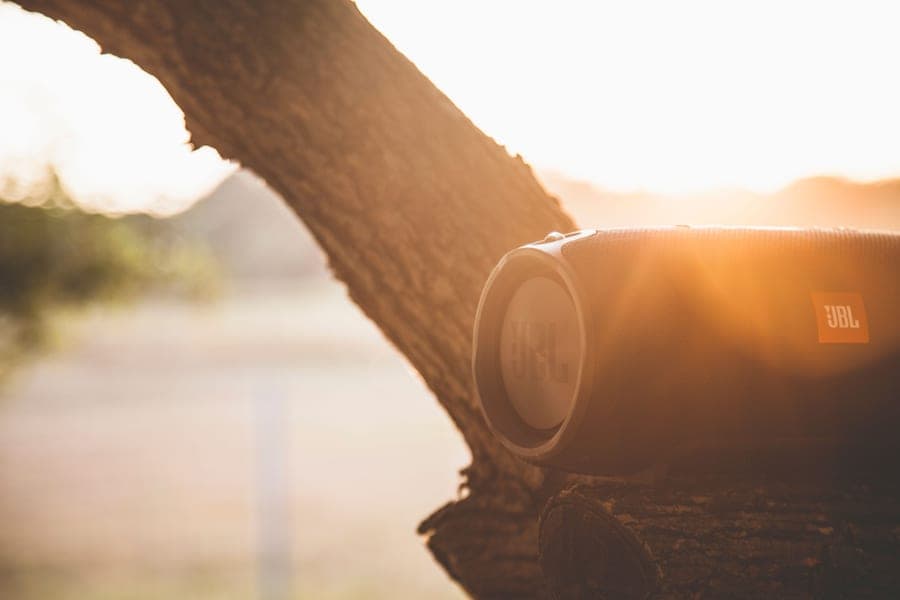 Illustrative IllustrativeJBL Flip 7IP68, 14 hours, and the current linking standard. | Best Auracast speaker to start with | Check price on Amazon |
| 3 |  Illustrative IllustrativeJBL Clip 5A carabiner, an Auracast button, very little bass. | Cheapest way into Auracast | Check price on Amazon |
| 4 |  Illustrative IllustrativeAnker Soundcore 2Two of these pair into a stereo set for less than one JBL. | The cheap way to get stereo | Check price on Amazon |
#ad — buy links go to Amazon and we earn a commission on qualifying purchases. Prices change constantly, so the live listing is always the price of record. Full disclosure.
Auracast replaced PartyBoost, and the two are not compatible. PartyBoost was JBL's own system for linking JBL speakers to each other. Auracast is part of the industry Bluetooth LE Audio standard, needs Bluetooth 5.2 or later, and broadcasts one-to-many rather than pairing one-to-one. Current JBL models — Go 4, Clip 5, Flip 7, Charge 6, Xtreme 4 — use Auracast. A PartyBoost-era Flip or Charge will not link with any of them. The JBL Xtreme 4 is the one exception: it supports both.
This matters far more than a feature name usually does, because linking a second speaker is one of the most common upgrade paths in this category. People buy one speaker, like it, and buy another of the same brand a year later expecting the two to work together. With JBL in this particular window, that expectation is often wrong, and the speaker you already own decides which one you should buy next.
It is also a genuinely good change, which makes the incompatibility more annoying rather than less. Auracast is an open standard rather than one brand's protocol, so in principle a JBL speaker can broadcast to Auracast speakers, headphones and earbuds from other manufacturers. PartyBoost could never do that.
What each one actually is
| PartyBoost | Auracast | |
|---|---|---|
| Who owns it | JBL — proprietary | Bluetooth SIG — industry standard |
| How it works | Links PartyBoost speakers to each other | One source broadcasts to many receivers |
| Requires | Two PartyBoost JBL speakers | Bluetooth 5.2 or later, LE Audio support |
| Cross-brand | No | Yes, in principle |
| Headphones and earbuds | No | Yes, if they support Auracast |
| Stereo pairing of two units | Yes | Yes |
| JBL models | Flip 6, Charge 5 era | Go 4, Clip 5, Flip 7, Charge 6, Xtreme 4 |
| Talks to the other system | No | No |
One practical detail worth knowing: because Auracast is a broadcast rather than a pairing, the number of speakers that can receive the same stream is not limited the way PartyBoost's linking was. That is the real reason JBL moved, and it is also why the feature is appearing on televisions and in public venues rather than only on speakers.
What this means for what you buy
- You own a PartyBoost-era JBL and want a second speaker. Buy another PartyBoost speaker, or buy the Xtreme 4, which supports both. A Flip 7 will not link with your Flip 6.
- You own a current Auracast JBL. Buy any other current JBL. They link cleanly and there is no app dance.
- You own nothing yet and want two speakers eventually. Start on Auracast. It is the standard going forward and it is not locked to JBL.
- You just want stereo for as little as possible. Do not buy into either system — buy two cheap speakers that pair to each other directly, as below.
- You want one speaker and will never add a second. Ignore this page entirely. Neither system affects how a single speaker sounds.
The picks
IllustrativeThe only JBL that bridges both systems
JBL Xtreme 4
Two woofers and two bass radiators — the most convincing low end JBL puts in a carryable box.
- What it does well
- Supports PartyBoost for older JBL speakers and Auracast for current ones, which no other model in the range does — so it is the single correct answer if you are adding to a PartyBoost collection but want a future-proof speaker. Two 70 mm woofers with dual bass radiators keep the low end composed at volume, and the battery is swappable.
- Where it cuts corners
- Heavy at 4.63 lb, expensive, and firmly above this site's value ceiling. No aux input. If you do not need the bridging or the battery swap, you are overpaying.
- Who it is for
- Owners of PartyBoost-era JBL speakers who want one more speaker that works with everything.
- Battery: Up to 24 hours, plus 6 more with Playtime Boost
- Water rating: IP67 — submersible to 1 m for 30 minutes, dustproof
- Output: Two 70 mm woofers and two 20 mm tweeters with dual bass radiators
- Weight: 4.63 lb (2.1 kg)
#ad — we earn a commission on qualifying purchases. How this is funded
IllustrativeThe Auracast speaker to start with
JBL Flip 7
The default mid-size pick, and the speaker every value brand is trying to undercut.
- What it does well
- IP68 sealing — the toughest on this site's product list — 14 hours plus a boost mode, USB-C lossless audio in, and Auracast linking that chains current JBL speakers without an app. The sensible first speaker if you expect to add more.
- Where it cuts corners
- A clear brand premium for a smaller cabinet than rivals offer at the same money, it is mono, and it will not link with any PartyBoost speaker you already own.
- Who it is for
- Buyers starting a JBL collection from scratch.
- Battery: 14 hours, plus up to 2 more in Playtime Boost mode
- Water rating: IP68 — submersible to 1.5 m for 30 minutes, dustproof
- Weight: 1.82 lb (about 560 g)
#ad — we earn a commission on qualifying purchases. How this is funded
IllustrativeThe cheapest way into Auracast
JBL Clip 5
The carabiner is the whole product, and it is a genuinely good one.
- What it does well
- An Auracast button on JBL's smallest sensible speaker, plus the integrated metal carabiner that is the real reason to buy a Clip at all. IP67, 12 hours, and an unusually clean midrange for the size.
- Where it cuts corners
- There is almost no bass, because there is almost no cabinet, and it is priced above rivals that sound similar purely on the strength of the clip. As a second Auracast speaker it adds coverage, not low end.
- Who it is for
- People who want to try Auracast cheaply, or who need the speaker clipped to something.
- Battery: 12 hours, plus up to 3 more in Playtime Boost mode
- Water rating: IP67 — submersible to 1 m for 30 minutes, dustproof
#ad — we earn a commission on qualifying purchases. How this is funded
IllustrativeThe cheap way to get stereo instead
Anker Soundcore 2
Years old, still sold, still the battery-life champion of the cheap shelf.
- What it does well
- Two of these pair directly into a genuine stereo set for less than the price of one mid-tier JBL, and they sound wider doing it than any single box at the money. Twenty-four hours each, IPX7, and still sold years after release.
- Where it cuts corners
- The design is visibly dated, there is no dust rating, and the treble is soft next to anything recent. The pairing is brand-specific — it will not link with JBL, Auracast or otherwise.
- Who it is for
- Anyone whose actual goal was stereo rather than a particular linking standard.
- Battery: 24 hours
- Water rating: IPX7 — submersible to 1 m for 30 minutes
- Output: 12 W stereo
#ad — we earn a commission on qualifying purchases. How this is funded
For the mechanics of actually linking two speakers — on iPhone, on Android and through each brand's own app — how to pair two Bluetooth speakers is the step-by-step guide. If the linking question came up because you are choosing between two JBL generations, Flip 7 vs Flip 6 and Clip 4 vs Clip 5 both turn on exactly this issue. And if all of this has made JBL's ecosystem look like a reason to shop elsewhere, that is a fair reading — JBL alternatives is the shortlist.
Frequently asked questions
Is Auracast compatible with PartyBoost?
Which JBL speakers have Auracast?
Is Auracast better than PartyBoost?
Can I link a JBL speaker to a Soundcore or Tribit speaker?
Do I need Auracast at all?
Update log
- First publication. The compatibility detail, including the Xtreme 4 being the one model that supports both systems, is sourced to SoundGuys' reporting on JBL's transition and to the Bluetooth SIG rather than inferred.
Sources
Every specification quoted above comes from the manufacturer or retailer listing below. We publish no measurements of our own — see how we pick.
- Bluetooth SIG — Auracast and Bluetooth LE Audio
- Bluetooth SIG — Bluetooth technology overview (profiles, codecs, LE Audio)
- SoundGuys — Goodbye JBL PartyBoost, hello Auracast
- What Hi-Fi? — JBL Flip 7 vs Flip 6 comparison
- JBL — Flip 7 product page (manufacturer specifications)
- JBL — Xtreme 4 specification sheet (PDF)
- JBL — Clip 5 specification sheet (PDF)
- Soundcore — Soundcore 2 product page (manufacturer specifications)
Read next
Guides
How to pair two Bluetooth speakers
Platform-by-platform steps for stereo and multi-speaker pairing — and why cross-brand does not work.
Head-to-Head
JBL Flip 7 vs Flip 6: is the newer one worth it?
Generation against discount — what the Flip 7 actually added and whether it justifies the gap.
Head-to-Head
JBL Clip 4 vs Clip 5: which should you buy?
What the Clip 5 actually changed, and when a discounted Clip 4 is the better buy.
Brands & Alternatives
JBL speakers: which one is actually worth buying
The JBL lineup decoded — what each model is for and which one a value buyer should pick.
Brands & Alternatives
JBL alternatives: what you actually give up going cheaper
Each popular JBL mapped to its cheaper equivalent, with the real cost of each swap stated.
Reviews
The benchmark speaker reviewed — what the premium buys and when it stops being worth it.