Guides
Why cheap Bluetooth speakers sound cheap
The honest physics behind the price ladder — and why some of it is not about price at all.
By Ryder M.Published
 Field-tested picks · 2026
How we are funded: Thump & Tote earns a commission when you buy through our Amazon links, at no extra cost to you. It never changes which speaker we put first — see how we pick and our affiliate disclosure.
Quick picks
Ranked for value first. Tap any row to jump to the full write-up.
| # | Product | Best for | Price |
|---|---|---|---|
| 1 |  Illustrative IllustrativeSoundcore Boom 2A real subwoofer, which is the only honest fix. | Solving it with hardware | Check price on Amazon |
| 2 |  Illustrative IllustrativeSoundcore Motion 300Stereo instead of pretending to have bass. | Working within limits | Check price on Amazon |
| 3 |  Illustrative IllustrativeTribit StormBox Micro 2A passive radiator, properly tuned. | Best of the small ones | Check price on Amazon |
#ad — buy links go to Amazon and we earn a commission on qualifying purchases. Prices change constantly, so the live listing is always the price of record. Full disclosure.
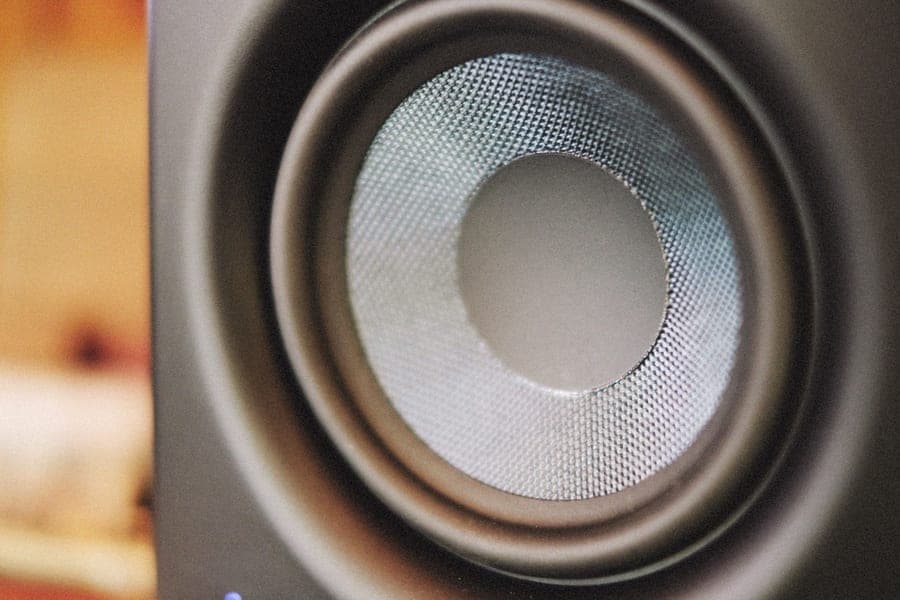
Cheap speakers sound cheap mostly because they are small, not because they are cheap. Producing low frequencies means physically moving a large volume of air, which requires driver area and cabinet space a small box does not have. A large inexpensive speaker frequently outperforms a small expensive one outdoors for exactly this reason.
This is the argument underneath every recommendation on this site, so it is worth setting out properly. Once you understand which limitations come from the price and which come from the physics, the whole category becomes much easier to shop — and a lot of the marketing stops working on you.
The air-moving problem
Sound is pressure variation in air. To produce a given loudness at a given frequency, a driver must displace a certain volume of air — cone area multiplied by how far it travels. Low frequencies require far more displacement than high ones, which is why a tweeter can be the size of a coin and a subwoofer cannot.
A speaker you can hold in one hand has a driver a few centimeters across and a cabinet of a few hundred milliliters. There is simply not enough of either to move the air that deep bass requires. This is not a manufacturing compromise or a cost saving; it is a physical constraint that applies identically to a $30 speaker and a $300 one of the same size.
What budget speakers do instead
Passive radiators — the honest fix
A passive radiator is an undriven cone tuned to resonate with the air movement the main driver creates inside the cabinet. It genuinely adds acoustic output around its tuning frequency, costs nothing to run, and is the reason a well-designed small speaker can sound dramatically fuller than a badly designed one of identical size. The Tribit StormBox Micro 2 is the clearest example on this site.
Bass-boost modes — the illusion
A bass-boost mode is equalization: it raises the level of low frequencies the speaker already produces. It cannot create output below what the driver can physically manage, so pushing it means asking the cone to travel further than it can — which produces distortion rather than bass, drains the battery faster, and reduces the headroom available before the amplifier clips.
| Passive radiator | Bass-boost mode | |
|---|---|---|
| What it is | A tuned undriven cone | Software equalization |
| Adds real output? | Yes, around its tuning frequency | No — raises existing output |
| Cost to battery | None | Significant |
| Cost to headroom | Minimal | Distorts sooner at volume |
| Can be disabled? | No, it is physical | Yes, and often should be |
Tuning choices — where the real skill is
Given a fixed cabinet, the most consequential decision a manufacturer makes is how to voice it. The tempting choice is a boosted upper-bass hump that sounds impressive on a demo track in a shop. The better choice is a flatter response that sounds less exciting for thirty seconds and considerably better for an hour. Brands that make the second choice — Bose most obviously, JBL fairly consistently — are what you are paying tuning expertise for.
What the price actually buys
- Cabinet volume — the one thing that reliably scales with price and genuinely changes what is possible.
- Better drivers — more excursion before distortion, which means more headroom rather than more bass.
- Acoustic tuning — a voicing that holds up over an hour rather than a demo.
- Build quality and sealing — durability, not sound.
And what it does not buy: water resistance, which has commoditized across every tier, or battery life, which does not track price at all. Those are covered in IPX7 and IP67 explained and battery life respectively.
The three approaches, illustrated
IllustrativeSolving it with hardware
Soundcore Boom 2
The value answer to a party speaker: it floats, it is loud, and it lasts a day.
- What it does well
- A dedicated 50 W subwoofer driver with two 15 W tweeters is the honest answer to the air-moving problem: a driver big enough to do the job, in a cabinet big enough to house it. Quoted response reaches down to 45 Hz.
- Where it cuts corners
- The price of that is size and weight. It is a deliberate carry, and its quoted battery figure assumes the bass processing is off.
- Who it is for
- Anyone who genuinely wants bass rather than an impression of it.
- Battery: Up to 24 hours at 50% volume with BassUp and lights off
- Water rating: IPX7 — submersible to 1 m for 30 minutes, and it floats
- Output: Up to 80 W peak output (a 50 W subwoofer plus two 15 W tweeters)
#ad — we earn a commission on qualifying purchases. How this is funded
IllustrativeWorking within the limits
Soundcore Motion 300
Our default recommendation under $100 — stereo, slim, and honestly specified.
- What it does well
- Rather than faking depth it does not have, it spends its engineering on stereo separation — which makes a small speaker sound wider and more convincing without asking the drivers to do the impossible. BassUp exists but is off by default, which is the right decision.
- Where it cuts corners
- The slim cabinet caps extension no matter what. This is warmth, not weight, and it is honest about that.
- Who it is for
- Listeners who want the speaker to sound good rather than impressive.
- Battery: 13 hours
- Water rating: IPX7 — submersible to 1 m for 30 minutes
- Output: 30 W stereo (two 15 W full-range drivers)
#ad — we earn a commission on qualifying purchases. How this is funded
IllustrativeThe passive radiator, done well
Tribit StormBox Micro 2
The best-argued cheap speaker on the market, and now a last-generation bargain.
- What it does well
- A properly tuned passive radiator extends usable low end far enough that people consistently guess the speaker is larger than it is. That is the correct engineering answer to a small cabinet, and it costs nothing to run.
- Where it cuts corners
- A radiator extends bass, it does not create it. Push the volume outdoors and the low end thins out fast because there is not enough driver behind it.
- Who it is for
- Small-space listening on a budget.
- Battery: Up to 12 hours
- Water rating: IP67 — submersible to 1 m for 30 minutes, dustproof
- Output: 10 W
- Weight: 315 g
#ad — we earn a commission on qualifying purchases. How this is funded
What to expect for your money
A reasonable set of expectations, given the physics: under $50, expect clear midrange, adequate volume for one room, and effectively no deep bass. Under $100, expect the same plus enough output for a patio and perhaps genuine stereo. Under $150, expect real low end for the first time. Above that, expect refinement rather than capability.
Set against those expectations, cheap speakers in 2026 are remarkably good, and disappointment almost always comes from expecting the physics to bend. Cheap speakers with good bass is the practical version of this page, and how to choose is the framework that follows from it.
Frequently asked questions
Are cheap Bluetooth speakers any good?
Why do cheap speakers have no bass?
Why are Bluetooth speakers so expensive?
Why are most Bluetooth speakers mono?
Does bass boost actually add bass?
Update log
- First publication. The editorial basis for the site's recommendations, set out explicitly.
Sources
Every specification quoted above comes from the manufacturer or retailer listing below. We publish no measurements of our own — see how we pick.
Read next
By Price
Cheap Bluetooth speakers with good bass in 2026
Real low end on a budget — which speakers use hardware rather than EQ, and the size below which it is impossible.

Guides
How to choose a Bluetooth speaker
The complete buying framework — the four specs that matter and the three that do not.

Guides
How many watts is loud for a speaker?
Why wattage figures cannot be compared across brands, and what genuinely predicts loudness.

By Price
The best Bluetooth speakers under $50 in 2026
More speaker than this money used to buy. Five picks and an honest account of what you lose.
Outdoor & Party
The loudest Bluetooth speakers for the money in 2026
Genuinely loud speakers ranked on output per dollar — and why wattage figures cannot be compared.
By Price
The best Bluetooth speakers under $30 in 2026
The cheapest speakers worth owning — and a clear account of what this money cannot buy.