Guides
How many watts is loud for a speaker?
The biggest number on the box is the least useful one. Here is what to read instead.
By Ryder M.Published
 Field-tested picks · 2026
How we are funded: Thump & Tote earns a commission when you buy through our Amazon links, at no extra cost to you. It never changes which speaker we put first — see how we pick and our affiliate disclosure.
Quick picks
Ranked for value first. Tap any row to jump to the full write-up.
| # | Product | Best for | Price |
|---|---|---|---|
| 1 |  Illustrative IllustrativeSoundcore Boom 2A real 50 W subwoofer, not a peak figure. | Loud, honestly specified | Check price on Amazon |
| 2 | Illustrative Tribit StormBox BlastIndependent testing, not marketing claims. | Loudest measured | Check price on Amazon |
| 3 |  Illustrative IllustrativeSoundcore Motion 30030 W stereo that covers a patio. | Loud enough for most | Check price on Amazon |
#ad — buy links go to Amazon and we earn a commission on qualifying purchases. Prices change constantly, so the live listing is always the price of record. Full disclosure.
There is no watt figure that reliably means "loud", because watts measure electrical power going in, not sound coming out — and brands quote them inconsistently, as peak or continuous, per driver or per system, without saying which. A 30 W speaker with a large cabinet routinely beats an 80 W one with a small cabinet.
This is the most consequential misunderstanding in portable audio, and the industry has no incentive to correct it. Wattage is free to print, sounds technical, and scales in a way that feels intuitive — twice the watts must be twice as loud. None of those intuitions survive contact with how the number is actually produced.
What a watt is measuring
A watt is a unit of electrical power. In a speaker specification it describes how much power the amplifier can deliver to the drivers. It says nothing about how efficiently those drivers convert that power into sound pressure, and efficiency varies enormously between designs. Two speakers drawing the same power can differ by a large margin in actual output.
| Convention | Effect on the number |
|---|---|
| Peak power | Typically double or more the continuous figure |
| Continuous (RMS) power | The honest measure, and the one least often printed |
| Per driver | A two-driver speaker may quote one driver's rating |
| Total system | Sums every driver, sometimes including a subwoofer |
Because no standard requires disclosure of which convention was used, two numbers from two manufacturers are simply not comparable. Within one brand's range they are a rough guide to relative size. Across brands, they are noise.
What does predict loudness
- Cabinet volume. The best single predictor, and one you can judge from a photo. More internal volume means more air moved, particularly at low frequencies.
- Driver area. More cone surface displaces more air at the same excursion. Two drivers beat one of the same size.
- A dedicated bass driver. A speaker where the low end has its own driver goes louder before distorting than one where a full-range driver does everything.
- Independently measured maximum SPL. Test houses like RTINGS publish comparable figures under consistent conditions. This is the only honest cross-brand number available.
The decibel question people actually mean
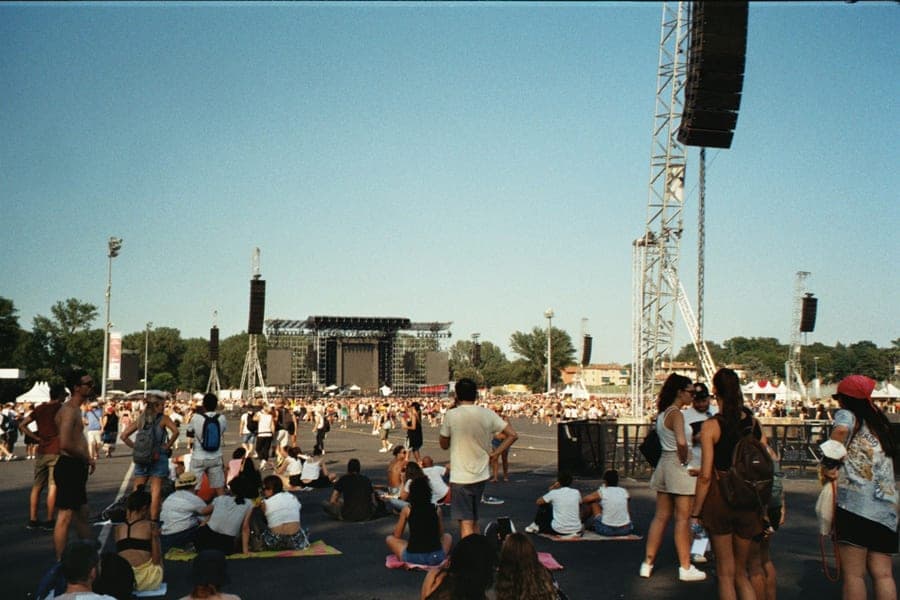
When someone asks how many watts is loud, they usually mean: will this be loud enough for my situation? That is a question about the space, not the speaker. Indoors, walls reflect sound back and a modest speaker sounds twice its size. Outdoors nothing comes back, and you need roughly four times the acoustic output for the same perceived loudness.
| Setting | What you need | Where to look |
|---|---|---|
| One person, a desk or a shower | Almost anything | Under $30 |
| A kitchen or a small room | A soda-can-sized speaker | Under $50 |
| A patio, four to six people | A 30 W class stereo speaker on a table | Under $100 |
| An open garden or tailgate | A dedicated bass driver | Under $150 |
| Open ground, a crowd | The biggest cabinet you will carry | Loudest for the money |
The free 6 dB nobody uses
Two more free improvements: get the speaker off the ground to ear height, because floors and grass absorb, and put a hard surface behind it, because boundary reinforcement genuinely adds low-frequency output. Together those are worth more than a tier upgrade. How to make a Bluetooth speaker louder covers the device-side settings as well.
Speakers that are honest about it
IllustrativeWhere the number means something
Soundcore Boom 2
The value answer to a party speaker: it floats, it is loud, and it lasts a day.
- What it does well
- Quotes up to 80 W peak but also breaks it down — a 50 W subwoofer and two 15 W tweeters — which is genuinely informative because it tells you the architecture rather than just a total. A dedicated bass driver is the thing that matters.
- Where it cuts corners
- The 80 W headline is still a peak figure, and the quoted twenty-four hours assumes the bass processing is off. Large enough to be a deliberate carry.
- Who it is for
- Parties and gardens where output is the point.
- Battery: Up to 24 hours at 50% volume with BassUp and lights off
- Water rating: IPX7 — submersible to 1 m for 30 minutes, and it floats
- Output: Up to 80 W peak output (a 50 W subwoofer plus two 15 W tweeters)
#ad — we earn a commission on qualifying purchases. How this is funded
IllustrativeWhere independent measurement exists
Tribit StormBox Blast
The loudest thing we are willing to call good value.
- What it does well
- Independent comparison testing puts it ahead of its closest price rival on maximum output with better directivity — a comparable, externally produced number rather than a marketing claim. Over thirty-two measured hours of battery.
- Where it cuts corners
- Heavy, and the LED bar drains the battery faster than anything else it does. Build quality trails JBL.
- Who it is for
- Anyone who genuinely needs to fill open ground.
- Battery: Over 32 hours in independent testing
- Water rating: IPX7 — submersible to 1 m for 30 minutes
#ad — we earn a commission on qualifying purchases. How this is funded
IllustrativeLoud enough for most people
Soundcore Motion 300
Our default recommendation under $100 — stereo, slim, and honestly specified.
- What it does well
- Thirty watts across two 15 W full-range drivers, which is plenty for a kitchen or a patio and is quoted as a system total rather than a peak. Stereo separation makes it sound larger than the number suggests.
- Where it cuts corners
- The slim cabinet limits output outdoors regardless of the wattage figure — a demonstration of this page's whole point.
- Who it is for
- Indoor and patio use.
- Battery: 13 hours
- Water rating: IPX7 — submersible to 1 m for 30 minutes
- Output: 30 W stereo (two 15 W full-range drivers)
#ad — we earn a commission on qualifying purchases. How this is funded
If you want the ranked answer rather than the theory, loudest for the money does it using physical characteristics and independent measurements. How to choose puts wattage in context with the specifications that do matter.
Frequently asked questions
How many watts is loud for a speaker?
Is 100 watts loud for a speaker?
What does wattage mean on a Bluetooth speaker?
Do more watts mean better sound quality?
How can I compare speaker loudness fairly?
Update log
- First publication. Four quoting conventions tabulated, which is why cross-brand comparison fails.
Sources
Every specification quoted above comes from the manufacturer or retailer listing below. We publish no measurements of our own — see how we pick.
- RTINGS — Tribit StormBox Blast vs Soundcore Rave Neo 2 comparison
- Soundcore — Boom 2 product page (manufacturer specifications)
- Soundcore — Motion 300 product page (manufacturer specifications)
- Tribit — StormBox Blast product page (manufacturer specifications)
- RTINGS — Soundcore Motion 300 measurements (independent test lab)
Read next
Outdoor & Party
The loudest Bluetooth speakers for the money in 2026
Genuinely loud speakers ranked on output per dollar — and why wattage figures cannot be compared.
Guides
How to choose a Bluetooth speaker
The complete buying framework — the four specs that matter and the three that do not.
Guides
How to make a Bluetooth speaker louder
The volume limits your phone applies by default, and the free placement gains that beat them.
By Price
Cheap Bluetooth speakers with good bass in 2026
Real low end on a budget — which speakers use hardware rather than EQ, and the size below which it is impossible.
Guides
Why cheap Bluetooth speakers sound cheap
The editorial spine of this site: what a small cabinet physically cannot do, and what it can.
Outdoor & Party
The best Bluetooth speakers for a backyard party in 2026
Party picks for gardens and patios — plus why two speakers often beat one bigger one.