Head-to-Head
Soundcore Boom 2 vs Boom 2 Plus
Same family, same floating body, very different speakers. One you carry, one you place.
By Ryder M.Published
 Field-tested picks · 2026
How we are funded: Thump & Tote earns a commission when you buy through our Amazon links, at no extra cost to you. It never changes which speaker we put first — see how we pick and our affiliate disclosure.
Quick picks
Ranked for value first. Tap any row to jump to the full write-up.
| # | Product | Best for | Price |
|---|---|---|---|
| 1 | 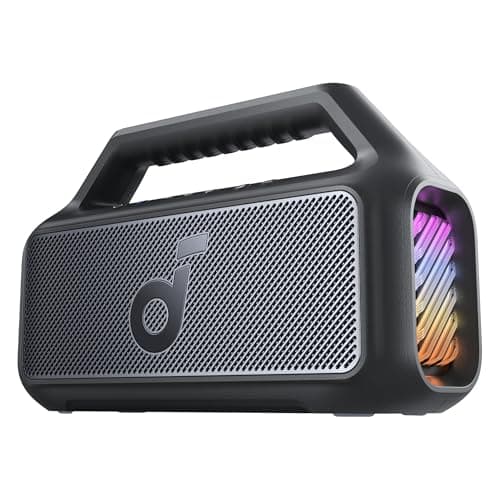 Soundcore Boom 280 W peak, 24 hours and a strap you can actually carry. | Best for most people | $99.99$129.9923% offView on Amazon |
| 2 | 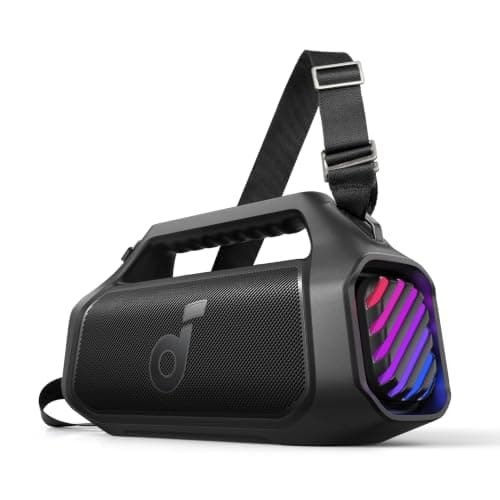 Soundcore Boom 2 PlusFour drivers, 140 W in BassUp, and a 3.5 mm aux jack. | Best if it stays put | $179.99$249.9928% offView on Amazon |
| 3 | 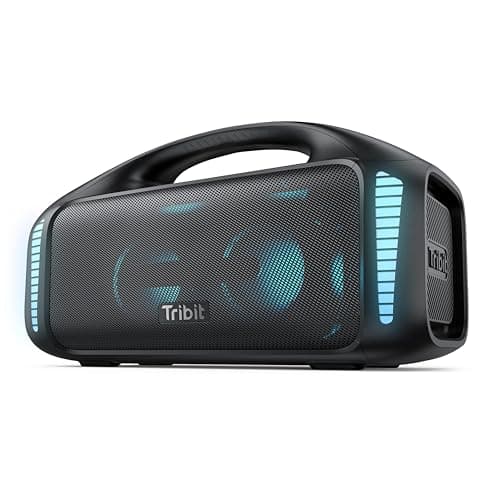 Tribit StormBox BlastOver 32 measured hours, an aux jack and a handle. | The alternative | $179.99$199.9910% offView on Amazon |
#ad — buy links go to Amazon and we earn a commission on qualifying purchases. Prices change constantly, so the live listing is always the price of record. Full disclosure.
Buy the Soundcore Boom 2 unless the speaker will live in one place. It is the one most people should own: 80 W peak from a 50 W subwoofer and two tweeters, a quoted 24 hours, IPX7, it floats, and a carry strap on a body light enough that you will actually take it places. The Boom 2 Plus adds a genuine four-driver layout, up to 140 W in BassUp 2.0, a 3.5 mm aux input and USB charging out — but it also weighs 8.4 lb and gives up four hours of quoted battery. The deciding question is whether you carry the speaker or place it.
These two get compared constantly because the naming suggests a simple upgrade, and it is not one. The Plus is not a better Boom 2; it is a different class of speaker that happens to share a family name. Going from one to the other costs you portability and battery and buys you drivers and inputs, and which side of that trade you want is decided almost entirely by where the speaker ends up on a Saturday.
| Soundcore Boom 2 | Soundcore Boom 2 Plus | |
|---|---|---|
| Drivers | One 50 W subwoofer, two 15 W tweeters | Two 50 W woofers, two 20 W tweeters |
| Output | Up to 80 W peak | 100 W standard, up to 140 W in BassUp 2.0 |
| Low end quoted to | 45 Hz | 40 Hz |
| Battery | Up to 24 hours at 50% volume, BassUp and lights off | Up to 20 hours at 50% volume, BassUp and lights off |
| Weight | Lighter, strap-carried | 8.4 lb |
| Wired input | None | 3.5 mm aux |
| Charges a phone | No | Yes, 10 W (5V/2A) out |
| Water rating | IPX7, and it floats | IPX7, and it floats |
| Lights | Light ring | RGB light show |
| Linking | TWS and Auracast | TWS and Auracast |
What the Plus actually adds
- A real four-driver layout. Two 50 W woofers and two 20 W tweeters instead of one subwoofer and two tweeters. This is the substantive difference and it shows where you would expect: the bass stays composed as you turn it up instead of folding into mush, because two woofers are each working half as hard as one would be.
- A 3.5 mm aux input. The feature that decides this comparison for a meaningful minority of buyers. A turntable, a TV, a mixer, a laptop with a dodgy Bluetooth stack — none of them can use the Boom 2 at all. The best speakers with an aux input explains why this jack has become rare.
- USB charging out. 10 W, enough to meaningfully revive a phone at a park. Not available on the Boom 2 at all.
- A little more low-end extension. 40 Hz quoted against 45 Hz. A real difference on paper, a subtle one in open air where low frequencies disperse anyway.
The picks
The one most people should buy
Soundcore Boom 2
The value answer to a party speaker: it floats, it is loud, and it lasts a day.
- What it does well
- Real subwoofer-driven low end rather than an EQ trick, a carry strap that makes the size manageable, and a floating IPX7 body that turns a pool drop into a non-event. Twenty-four quoted hours is four more than the Plus, and the lighter body is the reason it gets used on a Tuesday rather than only at a party.
- Where it cuts corners
- The 24-hour figure assumes 50% volume with BassUp and the light ring off — run it the way you want to and expect substantially less. It is still bulky enough to live in the car rather than a bag. No aux input and no USB charge-out at all, and IPX7 means dust is untested.
- Who it is for
- Backyards, pools, beaches and tailgates — anyone whose speaker moves around and whose source is always a phone.
- Battery: Up to 24 hours at 50% volume with BassUp and lights off
- Water rating: IPX7 — submersible to 1 m for 30 minutes, and it floats
- Output: Up to 80 W peak output (a 50 W subwoofer plus two 15 W tweeters)
#ad — we earn a commission on qualifying purchases. How this is funded · Price as of October 17, 2026
Buy this one if it stays in one place
Soundcore Boom 2 Plus
Two woofers, two tweeters and an aux jack — the most bass hardware per dollar in a carryable box.
- What it does well
- A genuine two-woofer, two-tweeter layout rather than one driver doing everything, so the low end stays composed as the volume climbs. It still floats, it is still IPX7, and unlike most speakers this size it keeps a 3.5 mm aux input and will charge a phone. One hundred and forty watts in BassUp is a lot of output for a battery speaker.
- Where it cuts corners
- At 8.4 lb this is a speaker you carry to a spot and leave there. The twenty-hour figure assumes BassUp and the lights are off, independent reviewers describe the BassUp tuning as wildly bass-heavy with the mids and highs set back behind it, and the single USB-C port means you cannot charge the speaker and a phone at the same time. IPX7 leaves dust untested.
- Who it is for
- Large patios, decks and driveway parties where the speaker lives in one place and output is the point — and anyone who needs a wired input.
- Battery: Up to 20 hours at 50% volume with BassUp and the light effects switched off
- Water rating: IPX7 — submersible to 1 m for 30 minutes, and it floats
- Output: 100 W as standard, up to 140 W in BassUp 2.0 mode, from two 50 W woofers and two 20 W tweeters
- Weight: 8.4 lb
#ad — we earn a commission on qualifying purchases. How this is funded · Price as of October 17, 2026
The alternative worth knowing about
Tribit StormBox Blast
The loudest thing we are willing to call good value.
- What it does well
- If the aux input is what is pulling you toward the Plus, this is the speaker to price against it: it has a 3.5 mm input too, a telescoping handle that beats a strap for a heavy speaker, and a battery independently measured past 32 hours — which is more than either Soundcore quotes, let alone delivers at volume.
- Where it cuts corners
- It is big and heavy enough that you plan around carrying it. The LED bar is the first thing to drain the battery, and fit and finish trails JBL noticeably. Tribit does not publish a comparable RMS figure, so there is no honest output comparison to make against the Soundcores.
- Who it is for
- Buyers who want the aux jack and the longest battery, and who do not need the speaker to float.
- Battery: Over 32 hours in independent testing
- Water rating: IPX7 — submersible to 1 m for 30 minutes
#ad — we earn a commission on qualifying purchases. How this is funded · Price as of October 17, 2026
Does the Plus actually sound better?
At volume, yes, and for a specific reason: splitting the bass load across two woofers means each one moves less air for the same output, and a driver working below its limit distorts less. That is why the Plus holds together at a level where the Boom 2 starts to compress — it is a headroom advantage rather than a tonality one.
At normal volume in a normal space, the difference is much smaller than the specification gap suggests, and there is a caveat worth taking seriously: independent reviewers describe the Plus's BassUp tuning as wildly bass-forward, with the mids and highs set back behind it. If you leave BassUp on by default — most people do — the Plus can sound less balanced than its smaller sibling, not more. The app EQ is there to fix it, but you have to go and use it.
The weight question, which is the real one
Three to four pounds does not sound like much written down, and it is decisive in practice. A speaker you can pick up with one hand along with a cooler and a chair gets used; a speaker that needs its own trip gets used at planned events only. Across a year that is the difference between a hundred uses and a dozen.
So the honest test is this: is there a specific spot — a deck, a patio, a finished basement — where this speaker will live? If yes, buy the Plus and enjoy the headroom and the aux jack. If the speaker's job description includes the word "and then", buy the Boom 2.
Where each one sits on the site
If the use case is a party rather than general outdoor listening, the best Bluetooth party speakers puts both of these in context against the JBL and Tribit alternatives. If you are weighing the Plus against JBL's flagship instead, Soundcore Boom 2 Plus vs JBL Charge 6 runs that comparison, and JBL Charge 6 vs Soundcore Boom 2 covers the smaller pairing.
Full write-ups for both models live at the Soundcore Boom 2 review and the Soundcore Boom 2 Plus review.
Frequently asked questions
What is the difference between the Soundcore Boom 2 and Boom 2 Plus?
Is the Boom 2 Plus worth the extra money?
Does the Soundcore Boom 2 have an aux input?
Do both the Boom 2 and Boom 2 Plus float?
Which has better battery life?
Update log
- First publication. Both models were in the registry and both review pages referenced this decision, but nothing targeted it.
Sources
Every specification quoted above comes from the manufacturer or retailer listing below. We publish no measurements of our own — see how we pick.
- Soundcore — Boom 2 product page (manufacturer specifications)
- Soundcore — Boom 2 support FAQ
- Soundcore — Boom 2 Plus product page (manufacturer specifications)
- Soundcore US — Boom 2 Plus outdoor bass speaker (current US listing)
- The Gadgeteer — Soundcore Boom 2 Plus review (independent hands-on)
- RTINGS — Tribit StormBox Blast measurements (independent test lab)
Read next
Reviews
Party-class bass hardware for the money — and the battery claim that needs translating.
Reviews
The most drivers per dollar in a carryable speaker — and the two things the listings do not lead with: the weight and the tuning.
Head-to-Head
Soundcore Boom 2 Plus vs JBL Charge 6: which should you buy?
140 W of bass hardware against a 2 lb speaker with a power bank — a weight decision disguised as a sound decision.
Head-to-Head
JBL Charge 6 vs Soundcore Boom 2: which should you buy?
The cross-brand matchup most buyers actually face — a real subwoofer against a power bank.
Outdoor & Party
The best Bluetooth party speakers in 2026
The four features that make a speaker a party speaker, and the five that genuinely have them.
By Price
The best Bluetooth speakers with an aux input in 2026
Speakers that kept the 3.5 mm jack, and the three jobs it does that Bluetooth cannot.