Head-to-Head
Bluetooth speaker vs bookshelf speakers
A fair comparison has to count the amplifier, the cables and the shelf space. Once it does, the answer gets clearer, not murkier.
By Ryder M.Published
 Field-tested picks · 2026
How we are funded: Thump & Tote earns a commission when you buy through our Amazon links, at no extra cost to you. It never changes which speaker we put first — see how we pick and our affiliate disclosure.
Buy bookshelf speakers if the listening happens in one room, in one chair, and you care enough to leave the music on rather than put it on. A proper stereo pair driven by an amplifier will outperform any portable Bluetooth speaker on soundstage, dynamics and low-end extension, and it is not close — two cabinets a metre apart do something no single box can imitate. Buy a Bluetooth speaker if the listening moves around, if the budget has to cover everything in one purchase, or if "one box, no cables" is itself a requirement. Most households that think they want bookshelf speakers actually want this, and it is not a compromise so much as a different product.
The comparison gets muddled because people price one against the other unfairly, in both directions. A pair of bookshelf speakers is not a complete system — it needs an amplifier, speaker cable, a source or a streaming input, and two stable surfaces about a metre apart at ear height. A Bluetooth speaker is a complete system, including the amplifier, the source connection, the battery and the enclosure, in one object you can hold.
Once both sides are priced honestly, the real question stops being about sound quality and starts being about what kind of listening you actually do. Those are two very different questions and only one of them has a universal answer.
What bookshelf speakers genuinely do better
- Stereo imaging that is real. Two cabinets separated by a metre or more produce a soundstage — instruments occupy positions between and around the speakers. Every single-box "stereo" speaker is trying to simulate this from drivers a few inches apart, and simulation is not the same thing. Mono vs stereo covers how much of the difference survives in practice.
- Low-end extension from physics, not processing. A bookshelf cabinet holds a driver several times the area of a portable's, in several times the internal volume. That produces bass that is present rather than suggested, without the compression every small speaker uses to fake it.
- Dynamics and headroom. An external amplifier has power a battery-driven speaker does not, so loud passages stay loud instead of being limited. This is the thing most people hear first and attribute to "better speakers".
- Upgradeability and lifespan. A passive speaker has no battery, no Bluetooth chip and no firmware. It does not go obsolete, it does not lose capacity, and it can outlive several amplifiers. How long Bluetooth speakers last is the other side of that coin.
What a Bluetooth speaker does better
- It is one purchase. Speaker, amplifier, source connection and power, in a box, working in ninety seconds. A bookshelf system is three purchases and an afternoon.
- It moves. Kitchen, bathroom, patio, car, a friend's house. A system that can only play in one room plays far less often than one that follows you.
- It needs no furniture. Bookshelf speakers need two surfaces a metre apart at roughly ear height, which in a real living room is a genuine constraint — and speakers crammed onto a shelf against a wall throw away much of the imaging advantage they were bought for.
- It survives things. The portables on this site are rated IP67 or IP68. A bookshelf speaker is a wooden box with a paper cone in it.
- It costs less, honestly counted. The full cost comparison is a pair of speakers plus an amplifier plus cable against one object. That gap is wider than the shelf price suggests.
| Bluetooth speaker | Bookshelf pair | |
|---|---|---|
| What you buy | One object | Two speakers, an amplifier, cable |
| Setup | Pair once, done | Placement, wiring, source configuration |
| Needs mains power | No — battery | Yes, for the amplifier |
| Stereo separation | Simulated, inches apart | Real, a metre or more apart |
| Moves between rooms | Yes | No |
| Survives outdoors | IP67 / IP68 on most picks here | No |
| Obsolescence | Battery and radio age | Passive speakers barely age |
If you want one box that still sounds serious
There is a narrow band of portables where the gap to a modest bookshelf system genuinely narrows — bigger cabinets, better drivers, and in one case a wired input so the speaker can take a real source. These are the three worth knowing about if this page has you weighing a portable against a system.
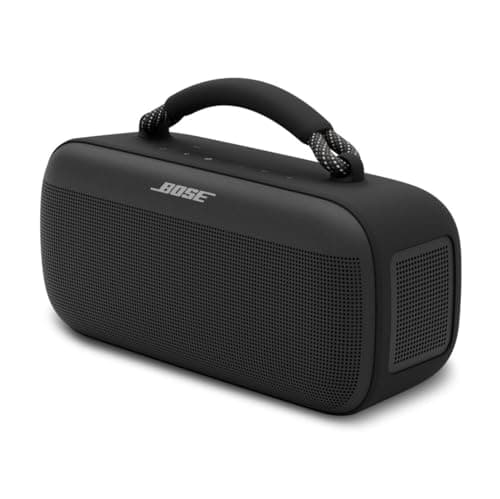
The portable that gets closest
Bose SoundLink Max
The best-sounding portable we know of, and the one that still has an aux jack.
- What it does well
- Tonally in a different class from everything cheaper — voices are natural and the bass is controlled rather than merely large. Crucially for this comparison, it keeps a 3.5 mm aux input when almost every rival has dropped one, so a turntable, a CD player or a TV can feed it directly. Two 25 W drivers in a 4.9 lb cabinet is real hardware by portable standards.
- Where it cuts corners
- It sits well above this site's usual ceiling, and at nearly 5 lb it is portable in the sense that a toolbox is portable. Twenty hours is beaten by speakers costing a quarter as much. And it is still one box — it cannot produce the soundstage two separated cabinets do, at any price.
- Who it is for
- Someone who wants the best single-box sound available and needs a wired input, in a room where a full system will not fit.
- Battery: Up to 20 hours
- Water rating: IP67 — submersible to 1 m for 30 minutes, dustproof
- Output: Two 25 W drivers
- Weight: 4.9 lb
#ad — we earn a commission on qualifying purchases. How this is funded · Price as of October 17, 2026
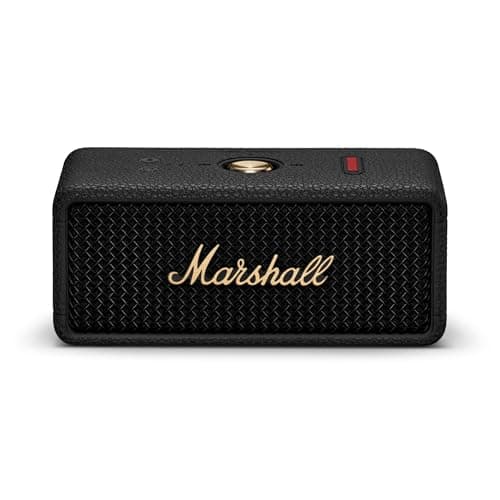
The one tuned like a hi-fi
Marshall Emberton III
Thirty-two hours and a genuinely grown-up tuning, in something you can pocket in a coat.
- What it does well
- If what draws you to bookshelf speakers is the idea of a restrained, honest tuning rather than a loud one, this is the portable that shares the goal — it sounds like a small hi-fi rather than a loud toy, and True Stereophonic throws sound multi-directionally so placement is forgiving. Thirty-two-plus hours means it never needs the socket a bookshelf system always needs.
- Where it cuts corners
- There is no aux input at all, so a turntable or a TV is out — which for anyone comparing against a hi-fi system is a significant omission. It is not especially loud for the money, and it cannot reach the low end a real cabinet does.
- Who it is for
- Listeners who want hi-fi character in something they can pick up, and who listen at moderate volume.
- Battery: 32+ hours, with 20 minutes of charging giving about 6 hours
- Water rating: IP67 — submersible to 1 m for 30 minutes, dustproof
- Output: Two 38 W Class D amplifiers driving two 10 W full-range drivers plus two passive radiators
- Weight: 1.5 lb (0.67 kg)
#ad — we earn a commission on qualifying purchases. How this is funded · Price as of October 17, 2026
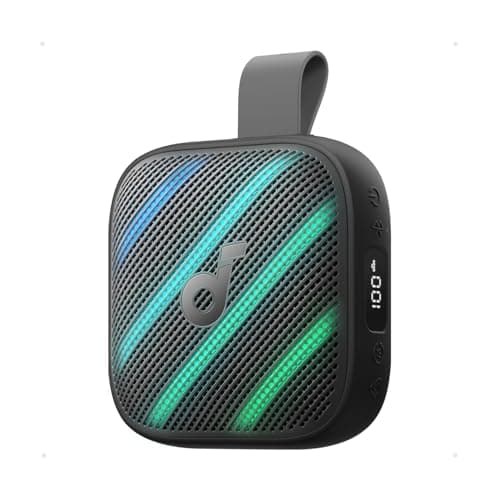
The cheap answer, if the honest answer is "background music"
Soundcore Boom Go 3i
Our default recommendation under $100 — tough, long-running and honestly specified.
- What it does well
- Most of what gets called a hi-fi requirement is actually a background-music requirement, and this covers it for a fraction of any system price: 15 W, 24 hours, an app EQ, and IP68 sealing so it moves to the kitchen or the patio without a thought. A pair of these linked over TWS gives you genuine separation for less than one bookshelf speaker.
- Where it cuts corners
- It is mono on its own, and fifteen watts will not fill a large living room. It is plainly a plastic object rather than a piece of furniture. Nobody is going to confuse it with a hi-fi, and this entry does not pretend otherwise.
- Who it is for
- The listener who suspected all along that the real requirement was music in the room rather than a listening chair.
- Battery: 24 hours, with a battery-level display on the speaker
- Water rating: IP68 — submersible and dust-tight, and drop-tested from 3.28 ft (1 m)
- Output: 15 W with BassUp 2.0, quoted at 92 dB peak
- Weight: 0.84 lb
#ad — we earn a commission on qualifying purchases. How this is funded · Price as of October 17, 2026
The question that actually decides it
Do you sit down to listen, or do you put music on? It sounds like a glib distinction and it is the whole thing. Bookshelf speakers reward being sat in front of — the imaging, the dynamics and the extension all show up most at the listening position, and much of the advantage evaporates if you are in the kitchen.
If the honest description of your listening is "music while I do things", the portable wins on every axis that matters to that behaviour: it is where you are, it needs no cables, and it cost a third as much. Buying a system for listening you do not actually do is the most common expensive mistake in home audio.
Can a Bluetooth speaker feed a bookshelf system?
Not the way people usually mean. A portable speaker is an endpoint, not a source — it cannot pass audio out to an amplifier. What you want instead is a Bluetooth receiver: a cheap box that pairs with your phone and outputs analogue or digital audio into an amplifier's input. That turns an existing system into a Bluetooth system for very little money, and it is a far better idea than trying to use a portable in the chain.
Going the other way — feeding a portable from a real source — only works on the small number of speakers that still have a wired input. The best Bluetooth speakers with an aux input is the list, and Bluetooth vs wired speakers covers the connection question in general. If what you are really solving is TV sound, Bluetooth speaker vs soundbar is the more relevant page.
Frequently asked questions
Are bookshelf speakers better than a Bluetooth speaker?
What do bookshelf speakers cost once you include everything?
Can I connect a Bluetooth speaker to a bookshelf system?
What about powered bookshelf speakers with Bluetooth built in?
Which Bluetooth speaker sounds closest to a hi-fi?
Update log
- First publication. Prices both sides as complete systems, which is where most comparisons of this pair go wrong.
Sources
Every specification quoted above comes from the manufacturer or retailer listing below. We publish no measurements of our own — see how we pick.
- Bose — SoundLink Max product page (manufacturer specifications)
- Marshall — Emberton III product page (manufacturer specifications)
- Soundcore — Boom Go 3i product page (manufacturer specifications)
- Bluetooth SIG — Bluetooth technology overview (profiles, codecs, LE Audio)
- IEC 60529 — the international standard behind IP ratings
Read next
Head-to-Head
Bluetooth speaker vs soundbar in 2026
Sync, dialogue, placement and cost - and the one condition that makes a portable the better TV buy.
Head-to-Head
Bluetooth vs wired speakers in 2026
What the cable actually buys you, what it costs you, and which one to buy for which job.
Head-to-Head
Mono vs stereo Bluetooth speakers
When stereo separation is audible, when it is marketing, and the four speakers that handle each case.
By Price
The best Bluetooth speakers with an aux input in 2026
Speakers that kept the 3.5 mm jack, and the three jobs it does that Bluetooth cannot.
By Price
The best sounding Bluetooth speakers in 2026
Ranked on tonal accuracy rather than loudness, with the point of diminishing returns marked.
Guides
How long do Bluetooth speakers last?
Product lifespan separated from battery runtime — what fails, when, and how to delay it.