Guides
Are Bluetooth speakers allowed on a cruise?
This is a line-by-line question, not a cruise-industry one. One major line names them in the banned list; another does not mention them at all.
By Ryder M.Published
 Field-tested picks · 2026
How we are funded: Thump & Tote earns a commission when you buy through our Amazon links, at no extra cost to you. It never changes which speaker we put first — see how we pick and our affiliate disclosure.
It depends entirely on the line, and the difference between them is stark. Carnival prohibits them outright — its published prohibited items list names "Boom boxes, Radios, Bluetooth speakers, Portable speakers, Wireless speakers, Any external speaker system", and the same policy requires guests to use earphones or headphones when listening to music in public areas. Royal Caribbean's prohibited items list does not mention speakers at all, though it adds that items not expressly listed may still be prohibited if the ship's security team deems them inappropriate. Before packing one, read your own line's prohibited items page — and assume that even where a speaker is allowed, using it on a public deck is not.
This question gets asked a lot and answered badly, usually with a blanket "cruise lines ban speakers" that is true of some lines and false of others. It is worth being precise, because the consequence of getting it wrong is a confiscated speaker at the terminal — most lines hold prohibited items for the duration of the sailing and return them at disembarkation, which is an annoyance rather than a loss, but an avoidable one.
The underlying reason for the rules is not a safety concern, unlike the lithium-battery rules that govern flying with a speaker. It is a noise and nuisance one. A cruise ship is an unusually dense environment: cabin walls are thin, balconies are separated by a partition rather than a wall, and a pool deck packs several hundred people into a space smaller than a tennis court. One speaker reaches a lot of people who did not choose it.
What the published policies actually say
- Carnival Cruise Line. Bluetooth speakers, portable speakers, wireless speakers, boom boxes, radios and any external speaker system are listed as prohibited items. The same policy states that guests must use earphones or headphones when listening to music or watching videos in public areas. This is explicit and unambiguous.
- Royal Caribbean. The prohibited items list does not name speakers. It does permit two-way radios under specified limits, and it includes a catch-all clause stating that items not expressly listed may still be prohibited if deemed unsafe or inappropriate for onboard operations, subject to review by the ship's security team.
- Every other line. Varies, and changes. Policies are updated between seasons and can differ by ship and by region. The only reliable source is the prohibited items page for your own booking, which is linked from the pre-cruise documentation.
What happens if you bring one anyway
On a line that prohibits them, bags are scanned at the terminal and prohibited items are typically removed and held by the ship's security team for the duration of the sailing, returned at the end. You lose the use of it and you spend time at the counter. There is no reason to risk it when the policy is published in advance and takes thirty seconds to check.
The other thing worth knowing is that a speaker found in a cabin during a routine visit — housekeeping, maintenance — can be removed the same way on a line that bans them. "It got through the scanner" is not a defence that survives a week.
What to pack instead
- Headphones or earbuds. The answer every line explicitly endorses, and the one that works in every space on the ship including the deck and the lounge.
- A small speaker, for lines that allow them and for shore days. Cabin use at low volume, a rented beach day, a private excursion. Small matters here in both directions: it draws less attention and it is genuinely enough in a cabin.
- Nothing at all. Worth saying. Most ships pipe music through public areas already, and a week without carrying a speaker around is not a hardship.
If you do pack one, the three below are the right shape for it — small, sealed against a pool or a rail, and cheap enough that losing one to a security counter or a wave is not a disaster. All three are IP67, which matters more on a ship than almost anywhere: salt spray, pool decks and shore excursions are the whole environment.
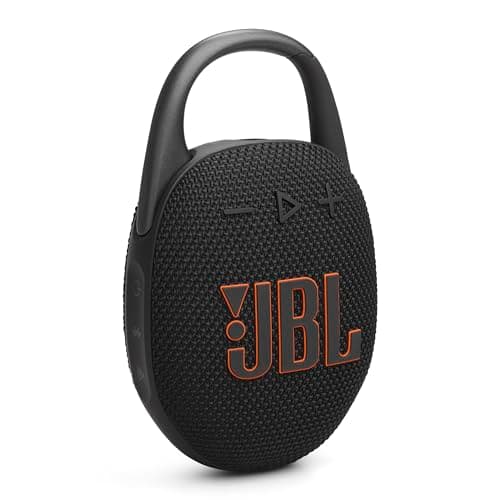
Best for a cabin and a shore day
JBL Clip 5
The carabiner is the whole product, and it is a genuinely good one.
- What it does well
- The integrated metal carabiner clips to a day bag, a balcony rail or a beach chair and holds, which is exactly how a speaker gets used on a trip. IP67 covers salt spray, a pool edge and a sudden shower on a shore excursion. For a speaker this small the midrange is unusually clean, which is what you need at the low volumes that are appropriate on a ship anyway.
- Where it cuts corners
- There is almost no bass, because there is almost no cabinet. It is priced well above rivals that sound similar, purely on the strength of the clip and the badge — which stings more when the speaker might spend the week in a security locker.
- Who it is for
- Cabin listening at low volume and shore days, on a line that permits speakers.
- Battery: 12 hours, plus up to 3 more in Playtime Boost mode
- Water rating: IP67 — submersible to 1 m for 30 minutes, dustproof
#ad — we earn a commission on qualifying purchases. How this is funded · Price as of October 17, 2026
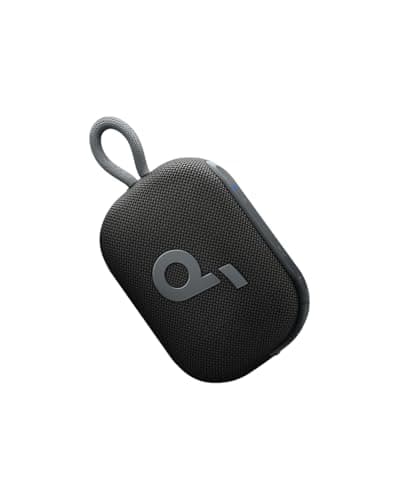
Cheapest thing worth packing
Soundcore Select 4 Go
The honest answer at the very bottom of the market.
- What it does well
- An IP67 rating and twenty quoted hours at a price where most rivals offer neither, in 265 g with an integrated strap. For a cruise that is precisely the right compromise: quiet enough to be appropriate in a cabin, cheap enough that a confiscation or a drop over a rail is irritating rather than expensive, and small enough to disappear into a day bag.
- Where it cuts corners
- Five watts is genuinely quiet — which is a feature in a cabin and a limitation on a beach. Bass is largely absent. It is not a speaker you would buy for home use.
- Who it is for
- Anyone who wants music in the cabin and on a beach day without carrying or risking anything substantial.
- Battery: 20 hours
- Water rating: IP67 — submersible to 1 m for 30 minutes, dustproof
- Output: 5 W
- Weight: 265 g
#ad — we earn a commission on qualifying purchases. How this is funded · Price as of October 17, 2026
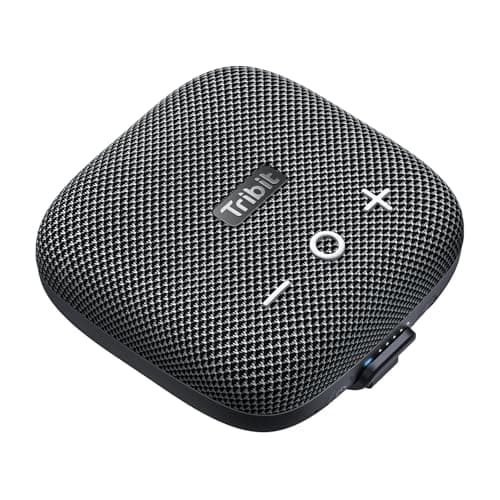
Best sound for the size
Tribit StormBox Micro 2
The best-argued cheap speaker on the market, and now a last-generation bargain.
- What it does well
- At 315 g it punches far past its size thanks to a passive radiator, which makes it the one here that is genuinely enjoyable rather than merely adequate on a private beach or a rented boat. The molded rubber strap wraps a balcony rail, a bag handle or a rail on a tender without any accessory, and IP67 handles salt spray.
- Where it cuts corners
- Ten watts still runs out of headroom outdoors with wind or surf. Twelve hours is the shortest battery of the three, which on a long shore day matters. It has been superseded by a Micro 3, so color availability is thinning.
- Who it is for
- Travellers who want the best sound that still fits the brief, and who will mostly use it off the ship.
- Battery: Up to 12 hours
- Water rating: IP67 — submersible to 1 m for 30 minutes, dustproof
- Output: 10 W
- Weight: 315 g
#ad — we earn a commission on qualifying purchases. How this is funded · Price as of October 17, 2026
Flying to the port?
Most cruises start with a flight, and the rules there are different again — they are about the lithium battery rather than the noise. The short version is that a speaker with a built-in battery travels in carry-on rather than checked baggage, and a loose spare battery is where people actually get stopped. Can you bring a Bluetooth speaker on a plane covers it properly.
One practical note for the connecting journey: a ship's Wi-Fi is frequently slow and sometimes metered, so download your music for offline playback before you leave home. A speaker is no help at all if the streaming app will not load, and mid-ocean is a bad place to discover it.
Frequently asked questions
Are Bluetooth speakers allowed on Carnival cruises?
Are Bluetooth speakers allowed on Royal Caribbean?
What happens if I bring a prohibited speaker on board?
Can I use a Bluetooth speaker on my cruise balcony?
What should I take instead of a speaker on a cruise?
Update log
- First publication. Both cruise-line policies quoted here were read from the lines' own published pages on 2026-10-17.
Sources
Every specification quoted above comes from the manufacturer or retailer listing below. We publish no measurements of our own — see how we pick.
- Carnival Cruise Line — Prohibited Items (official policy; names Bluetooth, portable and wireless speakers)
- Royal Caribbean — What items are prohibited onboard (official policy)
- FAA PackSafe — lithium batteries in carry-on and checked baggage
- TSA — What Can I Bring? Speakers
- JBL — Clip 5 specification sheet (PDF)
- Tom's Guide — Tribit StormBox Micro 2 review
Read next
Guides
Can you bring a Bluetooth speaker on a plane?
The FAA and TSA rules for speakers and their batteries, and the three best speakers to fly with.
By Price
The best Bluetooth speaker for travel
Four small speakers worth the bag space, and why a hotel room needs less speaker than you think.
Waterproof
The best Bluetooth speakers for the beach in 2026
Dust-sealed picks for sand and salt — and the one digit in the rating that decides this category.
Waterproof
The best Bluetooth speakers for the pool in 2026
Speakers that float as well as survive — plus why an IPX7 rating on its own is not enough here.
By Price
The best small Bluetooth speakers
Pocket and desk-sized picks, ranked on how much they get out of a cabinet that cannot be big.
Guides
How to clean a Bluetooth speaker
Cleaning the mesh, the ports and the seals safely — and which speakers survive a rinse.