Guides
How to spot a fake Bluetooth speaker
By the time the box is in your hands it is already too late. The tells are all in the listing.
By Ryder M.Published
 Field-tested picks · 2026
How we are funded: Thump & Tote earns a commission when you buy through our Amazon links, at no extra cost to you. It never changes which speaker we put first — see how we pick and our affiliate disclosure.
Check who the listing is shipped from and sold by before you check anything about the speaker. A genuine unit sold by the brand, by the marketplace itself, or by a named authorized retailer is the single strongest signal available to you. The classic counterfeit tells — a price far below everyone else, a seller name that is a string of random letters, a listing with no serial or model number, stock photos that do not match the described color — all cluster on the same handful of listings, and all of them are visible before you spend anything.
Counterfeit portable speakers are a real and growing problem, and they cluster around exactly the brands this site writes about: JBL most of all, then Bose and Marshall. The reason is simple — those are the names with enough brand value that a fake can be sold at a plausible discount rather than a suspicious one. U.S. Customs and Border Protection runs a public campaign on this specifically because counterfeit consumer electronics are also a safety problem, and the dangerous part of a fake speaker is not the sound, it is the unregulated lithium cell inside it.
This matters to a value-hunting audience more than most, because the entire skill being practiced here — finding the cheap listing — is also the skill that walks you into a counterfeit. The defense is not to stop looking for deals. It is to know which signals are cheap to check.
Check the listing first, in this order
- Shipped from and sold by. On a marketplace this is the whole game. Sold by the brand, by the marketplace itself, or by a retailer you could name out loud — buy it. Sold by a seller name that looks like a license plate — do not.
- The price gap. A small discount is normal. A large one on a current model, when every other listing clusters at a similar figure, is the most reliable single indicator that something is wrong. Genuine clearance happens on *superseded* models, which is why last-generation picks are the safe bargain.
- Model number precision. A genuine listing names the exact model and usually its variant code. A counterfeit listing tends to use the family name only, or stacks several model names into the title to catch more searches.
- The photographs. Manufacturer press images in a listing from an unknown seller tell you nothing about what ships. Real photographs of the actual unit, including the underside label, are a good sign and are rarely present on a fake listing.
- The review pattern. A current-model listing with hundreds of reviews that are all older than the model, or whose text describes a different product entirely, has had its listing identity changed. This is common and it is a red flag regardless of counterfeiting.
- Returns and warranty wording. Genuine listings say who honors the warranty. Counterfeit listings are vague, or offer a seller-administered "warranty" in place of the manufacturer's.
Check the box and the unit when it arrives
- Print quality on the packaging. Counterfeit boxes are usually a generation of photocopying away from the original — slightly soft type, slightly wrong color saturation, occasional spelling errors in the small print on the back.
- Regulatory marks. Genuine units carry FCC, CE and recycling marks, a model number and a serial number, molded or printed on the underside and on the box. A blank underside, or marks that are printed on a sticker rather than molded in, is a serious warning.
- A serial number that the brand can check. Several manufacturers will verify a serial number through their own support channel. If the seller refuses to provide it before shipping, that itself is information.
- Weight and density. Fakes are consistently lighter, because the magnet assembly and the battery are the expensive parts and both get substituted. If the speaker feels hollow next to the published weight, weigh it.
- The charging port and the flap. Counterfeits frequently add a microSD slot the genuine model does not have, because the donor design they were built from had one. A port that is not in the manufacturer's own specification is close to conclusive.
- Unexpected heat while charging. Stop using it. An unregulated lithium cell with no protection circuit is the actual hazard in a counterfeit, not the audio quality.
The speakers this happens to most
Counterfeiting follows brand value, so the models below are the ones to be most careful with — not because there is anything wrong with them, but because they are worth faking. All four are speakers we recommend; buy them from a source you can name.
 Illustrative
The most counterfeited speaker on this site
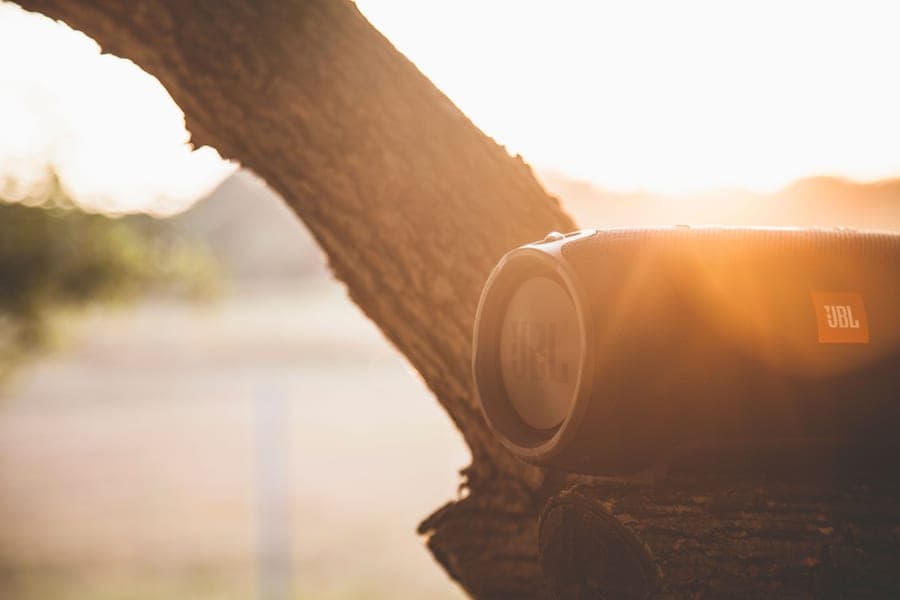
JBL Flip 7
The default mid-size pick, and the speaker every value brand is trying to undercut.
- What it does well
- Even tonality across the volume range, a genuinely rugged IP68 shell and Auracast linking. It is the model the whole value field is measured against, which is exactly why it is the one most worth faking.
- Where it cuts corners
- You pay the JBL premium in full and there is no aux input. The popularity that makes it good also makes the marketplace listings for it the ones to scrutinize hardest.
- Who it is for
- Buyers who want one competent speaker for everything — bought from JBL, the marketplace itself, or a retailer you could name.
- Battery: 14 hours, plus up to 2 more in Playtime Boost mode
- Water rating: IP68 — submersible to 1.5 m for 30 minutes, dustproof
- Weight: 1.82 lb (about 560 g)
#ad — we earn a commission on qualifying purchases. How this is funded
 Illustrative
The most faked small speaker
JBL Clip 5
The carabiner is the whole product, and it is a genuinely good one.
- What it does well
- The integrated metal carabiner is a genuinely good piece of design and holds reliably. For the size the midrange is unusually clean, and IP67 covers everything short of the sea.
- Where it cuts corners
- There is almost no bass, because there is almost no cabinet, and JBL charges well above rivals that sound similar. Counterfeits of this model are common precisely because the small size keeps the fake's cost down.
- Who it is for
- Anyone who needs the speaker attached to something rather than sitting on it.
- Battery: 12 hours, plus up to 3 more in Playtime Boost mode
- Water rating: IP67 — submersible to 1 m for 30 minutes, dustproof
#ad — we earn a commission on qualifying purchases. How this is funded
 Illustrative
The value pick worth buying genuine
Soundcore Boom 2
The value answer to a party speaker: it floats, it is loud, and it lasts a day.
- What it does well
- A dedicated 50 W subwoofer plus two 15 W tweeters — real hardware rather than an EQ curve — a carry strap, and a body that floats. Anker's own warranty handling is among the better experiences in the value field, which is a reason to buy through a channel that honors it.
- Where it cuts corners
- The quoted 24 hours assumes BassUp and the lights are off, and it is bulky enough to live in the car. A counterfeit of this model loses the separate subwoofer, which is the entire point of it.
- Who it is for
- Backyards, pools and tailgates where output matters more than refinement.
- Battery: Up to 24 hours at 50% volume with BassUp and lights off
- Water rating: IPX7 — submersible to 1 m for 30 minutes, and it floats
- Output: Up to 80 W peak output (a 50 W subwoofer plus two 15 W tweeters)
#ad — we earn a commission on qualifying purchases. How this is funded
 Illustrative
The safe cheap buy
Tribit StormBox Micro 2
The best-argued cheap speaker on the market, and now a last-generation bargain.
- What it does well
- A passive radiator rather than a bass-boost mode, a molded strap that needs no accessory, and — relevant here — a price low enough that counterfeiting it is not worth anyone's trouble. Being superseded by the Micro 3 makes it a genuine clearance bargain rather than a suspicious one.
- Where it cuts corners
- Ten watts runs out of headroom outdoors, and colors are thinning as stock clears. Tribit's street pricing swings widely, so check before assuming it is cheap.
- Who it is for
- Anyone who wants the deal without the counterfeit risk — the discount here is real and the brand is not worth faking.
- Battery: Up to 12 hours
- Water rating: IP67 — submersible to 1 m for 30 minutes, dustproof
- Output: 10 W
- Weight: 315 g
#ad — we earn a commission on qualifying purchases. How this is funded
What to do if you already bought one
- Stop charging it unattended. The battery is the hazard, not the sound. Charge it only where you can see it, or not at all.
- Open a return on the grounds of inauthenticity, not on the grounds of disappointment. Marketplaces treat counterfeit claims differently from ordinary returns, and the wording changes the outcome.
- Report the listing to the brand. Manufacturers run brand-protection programs with the major marketplaces and act on reports, which is why the programs exist.
- Do not simply resell it. Passing a counterfeit on is its own problem, and the battery risk goes with it.
The underlying advice
The reliable protection is structural rather than forensic: buy current models from a source you can name, and take your discounts on superseded models instead of on current ones. That is also, independently, the best value strategy in this category — the gap between last year's flagship and this year's is almost always smaller than the gap in price, which is the argument running through JBL alternatives and best for the money.
And be suspicious of your own excitement. The listing that feels like a find is the listing to slow down on. Everything on this page takes about ninety seconds to check, and ninety seconds is a good trade against a speaker that is both worse and potentially unsafe.
Frequently asked questions
How can I tell if a JBL speaker is fake?
Why are counterfeit Bluetooth speakers dangerous?
Is a big discount on a Bluetooth speaker always a fake?
What should I do if I bought a counterfeit speaker?
Which Bluetooth speakers get counterfeited most?
Update log
- First publication. Ordered around pre-purchase listing checks rather than post-purchase box inspection, because the listing signals are free and the box signals arrive too late. Counterfeit safety framing from U.S. Customs and Border Protection.
Sources
Every specification quoted above comes from the manufacturer or retailer listing below. We publish no measurements of our own — see how we pick.
- U.S. Customs and Border Protection — Fake Goods, Real Dangers
- Amazon Brand Services — brand protection and counterfeit programs
- Amazon Associates Program — Operating Agreement
- JBL — Flip 7 product page (manufacturer specifications)
- JBL — Clip 5 specification sheet (PDF)
- Soundcore — Boom 2 product page (manufacturer specifications)
- Tom's Guide — Tribit StormBox Micro 2 review
Read next
Brands & Alternatives
JBL dupes: the cheaper versions worth buying
Genuine cheaper equivalents versus outright knockoffs — and how to tell a fake listing apart.
Brands & Alternatives
JBL alternatives: what you actually give up going cheaper
Each popular JBL mapped to its cheaper equivalent, with the real cost of each swap stated.
Brands & Alternatives
The best Bluetooth speaker brands
What each major brand is actually good at, with the one model that makes its case.
Brands & Alternatives
Is JBL worth it? A direct answer
The brand-premium question answered directly, with the one variable that decides it.
By Price
The best Bluetooth speaker for the money in 2026
The single best-value speaker at each price point, plus the two tactics that save the most money.
Guides
How to choose a Bluetooth speaker
The complete buying framework — the four specs that matter and the three that do not.