Outdoor & Party
The best Bluetooth speaker for hiking
On a trail the speaker you regret is the one you felt. Weight decides this purchase, and the good news is that cheap wins.
By Ryder M.Published
 Field-tested picks · 2026
How we are funded: Thump & Tote earns a commission when you buy through our Amazon links, at no extra cost to you. It never changes which speaker we put first — see how we pick and our affiliate disclosure.
Quick picks
Ranked for value first. Tap any row to jump to the full write-up.
| # | Product | Best for | Price |
|---|---|---|---|
| 1 | 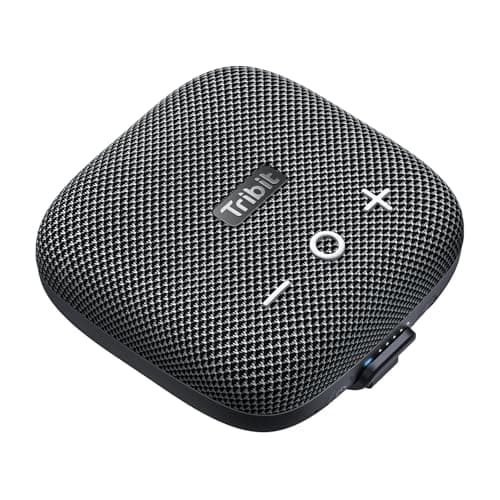 Tribit StormBox Micro 2315 g, a molded strap, and more sound than its size suggests. | Best overall | $39.99$59.9933% offView on Amazon |
| 2 | 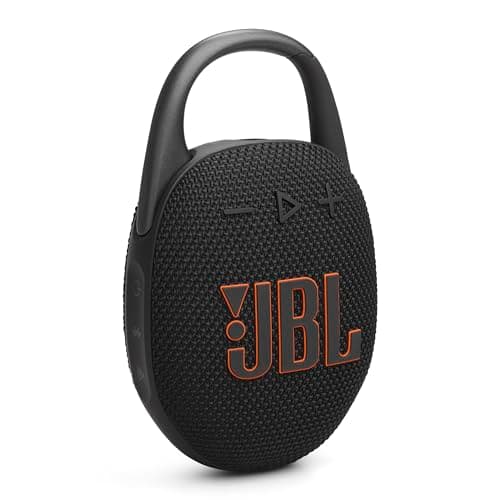 JBL Clip 5An integrated metal carabiner that actually holds. | Best clip | $59.95$79.9525% offView on Amazon |
| 3 | 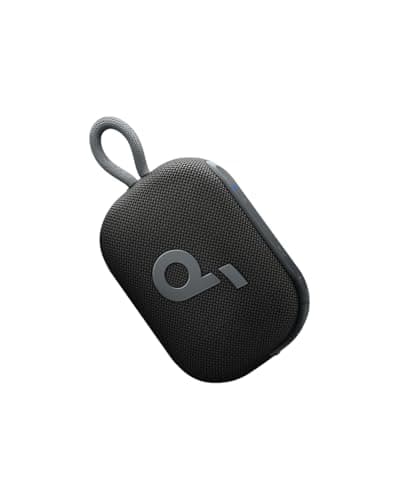 Soundcore Select 4 Go265 g, IP67 and 20 hours at the bottom of the market. | Lightest and cheapest | $22.99$34.9934% offView on Amazon |
| 4 | 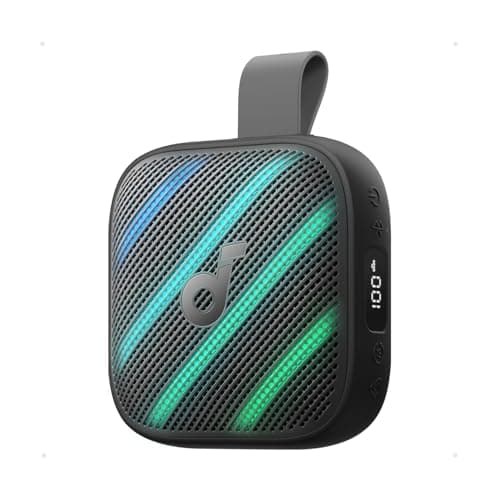 Soundcore Boom Go 3i24 hours and IP68 for 0.84 lb. | Best for multi-day trips | $59.99$79.9925% offView on Amazon |
#ad — buy links go to Amazon and we earn a commission on qualifying purchases. Prices change constantly, so the live listing is always the price of record. Full disclosure.
The Tribit StormBox Micro 2 is the best Bluetooth speaker for hiking, because at 315 g with a molded rubber strap built into the body it is the best ratio of sound to carried weight we know of — it mounts to a pack strap with no accessory, it is IP67 against rain and grit, and it costs little enough that a scrape on a rock is not a tragedy. If you want the lightest and cheapest thing that still has a real IP67 rating, the Soundcore Select 4 Go is 265 g and quoted at 20 hours.
Hiking is the one use case on this site where the usual advice inverts completely. Everywhere else, spending more buys a bigger cabinet and better sound. On a trail, a bigger cabinet is weight you carry uphill for hours — and the speaker that is a joy in a backyard is the one you resent at mile six.
That makes this a cheap category. The speakers that win here are small, and small speakers are inexpensive. The entire top of this page sits in the sub-$50 band, and the most expensive pick is here for its battery rather than its sound.
A word on other people
Worth saying plainly, because it is the most common complaint about speakers on trails: sound carries a very long way outdoors, especially across a valley or above the treeline, and a great many people hike specifically for quiet. Many public lands have noise rules, and a few prohibit amplified audio outright on particular trails. The practical answer is to keep the volume low enough that it does not travel past your own group, switch it off when you meet anyone, and use headphones on busy trails. Every speaker on this page is small enough to be used politely.
What actually matters on a trail
- Weight, first and by a distance. Under 350 g is the band worth shopping. Above about 500 g you will feel it on a long day, and above a kilogram you will leave it at home after the first trip.
- An attachment that is part of the speaker. A carabiner or a molded strap beats any aftermarket clip, because the thing you bolt on is the thing that fails. A speaker swinging loose off a pack strap is also a speaker banging against your hip for five hours.
- IP67 as the floor. Rain, dropped in a stream, set down in mud — all routine on a trail, none of them survivable by a speaker with no rating. IP67 covers dust and brief submersion, which is the realistic set of threats.
- Battery measured in days, not hours. You are not charging anything out there. Twelve quoted hours covers a day hike comfortably; for an overnight or longer, look at the 20-hour-plus picks and remember that quoted figures assume half volume.
- Midrange, not bass. No speaker this size produces meaningful bass and the ones that claim to are compressing to fake it. Open air swallows low frequencies anyway. A clean midrange at modest volume is what sounds good outdoors.
| Speaker | Weight | Battery | IP rating | How it attaches |
|---|---|---|---|---|
| Tribit StormBox Micro 2 | 315 g | Up to 12 hours | IP67 | Integrated rubber strap |
| JBL Clip 5 | Not published here | Check the current listing | IP67 | Integrated metal carabiner |
| Soundcore Select 4 Go | 265 g | 20 hours | IP67 | Integrated strap |
| Soundcore Boom Go 3i | 0.84 lb (about 380 g) | 24 hours | IP68, drop-tested from 1 m | Convertible clip-and-carry strap |
The picks
Best speaker for hiking overall
Tribit StormBox Micro 2
The best-argued cheap speaker on the market, and now a last-generation bargain.
- What it does well
- The molded rubber strap is part of the body rather than an accessory, so it goes round a pack strap, a trekking pole or a tent pole with nothing to lose or break. For 315 g it punches far past its size thanks to a passive radiator — this is the lightest speaker here that still sounds like a speaker rather than a phone. IP67 covers rain and a drop in a stream.
- Where it cuts corners
- Ten watts is modest, and in wind or beside running water it runs out of headroom quickly. Twelve hours covers a day hike but not a weekend without a battery pack. It has been superseded by a Micro 3, which is why it is cheap and also why color choices are thinning.
- Who it is for
- Day hikers and weekenders who want the most sound per gram and a mount that is already attached.
- Battery: Up to 12 hours
- Water rating: IP67 — submersible to 1 m for 30 minutes, dustproof
- Output: 10 W
- Weight: 315 g
#ad — we earn a commission on qualifying purchases. How this is funded · Price as of October 17, 2026
Best attachment on any speaker here
JBL Clip 5
The carabiner is the whole product, and it is a genuinely good one.
- What it does well
- The integrated metal carabiner is the whole product and it is a genuinely good one — it clips to a backpack strap, a belt loop or a tent guy line and it holds, which is more than can be said for most fabric loops. For a speaker this small the midrange is unusually clean, which is the frequency range that matters outdoors, and IP67 covers a wet day properly.
- Where it cuts corners
- There is almost no bass, because there is almost no cabinet — which matters less on a trail than anywhere else, but it is the honest description. It is also priced well above rivals that sound similar, purely on the strength of the clip and the badge.
- Who it is for
- Hikers who want the speaker clipped to the outside of a pack and forgotten about, and who will pay for a clip that does not let go.
- Battery: 12 hours, plus up to 3 more in Playtime Boost mode
- Water rating: IP67 — submersible to 1 m for 30 minutes, dustproof
#ad — we earn a commission on qualifying purchases. How this is funded · Price as of October 17, 2026
Lightest and cheapest
Soundcore Select 4 Go
The honest answer at the very bottom of the market.
- What it does well
- Two hundred and sixty-five grams with an IP67 rating and twenty quoted hours, at a price where most rivals offer neither. For a trail that is the right set of compromises: the battery covers an overnight, the rating covers the weather, and the weight is low enough that you genuinely forget it is on the pack. The integrated strap threads a carabiner.
- Where it cuts corners
- Five watts is genuinely quiet. This is a speaker for one or two people sitting at a viewpoint or in a tent, and it will be embarrassed in wind or beside a river. Bass is essentially absent.
- Who it is for
- Ultralight hikers, backpackers counting grams, and anyone who wants a speaker cheap enough to risk on rock.
- Battery: 20 hours
- Water rating: IP67 — submersible to 1 m for 30 minutes, dustproof
- Output: 5 W
- Weight: 265 g
#ad — we earn a commission on qualifying purchases. How this is funded · Price as of October 17, 2026
Best for multi-day trips
Soundcore Boom Go 3i
Our default recommendation under $100 — tough, long-running and honestly specified.
- What it does well
- Twenty-four quoted hours with a real battery-percentage display is the thing that matters when there is no socket for three days — you can ration it properly instead of guessing from three LEDs. IP68 is dust-tight as well as submersible and it is drop-tested from 1 m, the strongest durability spec on this site. Fifteen watts also means it is the only pick here with headroom in wind.
- Where it cuts corners
- At 0.84 lb it is the heaviest speaker on this page, which on a long trip is the whole argument against it. It is mono, it does not float despite the rating, and the light modes are the fastest way to spend the battery you bought it for.
- Who it is for
- Multi-day hikers, hut-to-hut trips, and groups who want enough volume to share at a campsite.
- Battery: 24 hours, with a battery-level display on the speaker
- Water rating: IP68 — submersible and dust-tight, and drop-tested from 3.28 ft (1 m)
- Output: 15 W with BassUp 2.0, quoted at 92 dB peak
- Weight: 0.84 lb
#ad — we earn a commission on qualifying purchases. How this is funded · Price as of October 17, 2026
Hiking or camping? They want different speakers
It is worth being clear about which you are doing, because the answers diverge sharply. Camping — driving to a site, setting up, staying put — makes size nearly free, so the right speaker is a much bigger one with a much better sound. The best Bluetooth speakers for camping is written around exactly that, and almost nothing on that page would be sensible to carry up a mountain.
Hiking is the opposite: every gram is carried, so the speaker is a compromise you make willingly. If your trip is a hike in to a campsite you then stay at, pick by the walk rather than the campsite — you will spend more hours carrying it than listening to it.
A note on batteries in the cold
Lithium batteries lose capacity in the cold, temporarily. A speaker quoted at twenty hours will deliver noticeably less on a frosty morning, and a nearly flat speaker can shut down abruptly rather than fading. The fix is simple: on cold trips keep the speaker inside the pack rather than clipped to the outside, and sleep with it in the tent rather than in the vestibule.
The capacity comes back when it warms up, so a speaker that dies at dawn is often fine by mid-morning. What is genuinely harmful is charging a battery that is below freezing — if you are running a power bank on the trail, let the speaker warm up first. Cold-weather use covers the whole picture, and how long speakers last explains what shortens a battery's life permanently.
Frequently asked questions
What is the best Bluetooth speaker for hiking?
How much should a hiking speaker weigh?
Is it rude to play music on a hiking trail?
Do I need a waterproof speaker for hiking?
How long will a hiking speaker's battery last in the cold?
Update log
- First publication. Ranked on carried weight rather than sound quality, which is the inversion this use case requires.
Sources
Every specification quoted above comes from the manufacturer or retailer listing below. We publish no measurements of our own — see how we pick.
- Tom's Guide — Tribit StormBox Micro 2 review
- TechRadar — Tribit StormBox Micro 3 review (confirms Micro 2 is superseded)
- JBL — Clip 5 specification sheet (PDF)
- Soundcore — Boom Go 3i product page (manufacturer specifications)
- IEC 60529 — the international standard behind IP ratings
- Apple — maximizing battery performance and lifespan
Read next
Outdoor & Party
The best Bluetooth speakers for camping in 2026
Campsite picks chosen for battery and packability rather than volume — the opposite of a party speaker.
Outdoor & Party
The best Bluetooth speakers for a bike in 2026
Handlebar-friendly picks judged on how they mount and how they cope with wind.
Guides
Bluetooth speakers in cold weather
Why cold halves your runtime, what damage is permanent, and the three speakers that handle winter best.
Guides
Bluetooth speaker battery life, honestly
How quoted runtimes are produced, what to expect in reality, and the longest-lasting picks.
By Price
The best small Bluetooth speakers
Pocket and desk-sized picks, ranked on how much they get out of a cabinet that cannot be big.
Guides
How long do Bluetooth speakers last?
Product lifespan separated from battery runtime — what fails, when, and how to delay it.