Guides
Bluetooth speakers in cold weather
Your battery has not broken. Lithium cells deliver far less at 20 degrees, and most of it comes back when they warm up.
By Ryder M.Published
 Field-tested picks · 2026
How we are funded: Thump & Tote earns a commission when you buy through our Amazon links, at no extra cost to you. It never changes which speaker we put first — see how we pick and our affiliate disclosure.
Cold does not usually break a Bluetooth speaker, but it does two things you will notice immediately: runtime drops sharply — commonly by a third to a half near freezing — and the speaker may refuse to charge at all below about 0 °C, which is a deliberate protection rather than a fault. Most of the lost capacity comes straight back when the speaker warms up, so nothing is damaged. The permanent damage comes from the opposite mistake: charging a cell while it is still freezing, which plates lithium inside it and shortens its life for good. Keep the speaker inside your coat, let it warm to room temperature before plugging it in, and winter is a non-event.
This question gets asked in two different ways and both deserve an answer. The first is "is my speaker broken?" — asked by someone whose twenty-four hour speaker just managed nine hours on a ski trip. It is not broken. The second is "which speaker should I buy for cold weather?" — asked by someone shopping for a snowboarding, ice-fishing, winter-camping or cold-garage speaker. The honest answer there is that no manufacturer publishes a cold-weather rating, so the choice comes down to battery size, build and where you carry it.
What cold actually does to a battery
A lithium-ion cell works by moving lithium ions through a liquid electrolyte. Cold makes that electrolyte more viscous and slows the chemistry down, so the cell's internal resistance rises. Higher resistance means the voltage sags further under load, and because a speaker shuts down at a fixed low-voltage threshold, it hits that threshold while there is still charge left in the cell. The energy has not gone anywhere — it is simply not available at that temperature.
That is why the effect is reversible. Bring the speaker indoors, let it reach room temperature, and the capacity returns. It is also why the loss is worse when you are playing loudly: high volume means high current draw, and high current draw is exactly what a cold cell handles worst. A speaker that manages six hours at full volume in the snow might manage twelve at half volume on the same charge.
Most consumer lithium cells are specified for discharge down to around −20 °C and for charging only above 0 °C. Those two numbers are the whole story, and the gap between them is the single most important thing to know: a speaker will happily play in the cold, and should not be charged there.
What else the cold affects
- Plastics and rubber go brittle. A speaker that survives a drop in summer may crack in the same fall at −10 °C, because the shell is stiffer and absorbs less. This is the main physical risk, and it is why a drop-rated speaker is worth more in winter.
- Condensation when you bring it in. Taking a cold speaker into a warm room makes moisture condense on and inside it, which no IP rating covers — IP ratings test water from outside, not water forming inside. Leave it in a bag for half an hour to warm up gradually.
- Touch controls get awkward. Capacitive buttons and gloves do not mix. Physical buttons are a real advantage in winter, and nobody lists it as a feature.
- Bluetooth itself is unaffected. Radio range and connection stability do not meaningfully change with temperature. If a speaker drops out in the cold it is almost always the battery sagging under load, not the radio. Why your speaker keeps cutting out covers the real causes.
- Sound changes very slightly. Cold stiffens a driver's suspension, which can make the bass marginally tighter and quieter. It is real and it is small — far smaller than the effect of being outdoors in the first place.
What to look for in a cold-weather speaker
- A big quoted battery, because you will only get part of it. The practical rule is to buy roughly twice the runtime you think you need. A twenty-four hour speaker that loses a third still covers a long day; a twelve-hour speaker does not.
- A dust rating, not just water. IP67 or IP68 rather than IPX7. Snow is water, but winter is also grit, salt and the fine dust of a cold dry day, and the X in IPX7 means that axis was never tested. What IPX7 and IP67 actually mean covers the scale.
- Physical buttons. You will be wearing gloves.
- Drop resistance, more than in summer. Cold plastic breaks more easily, and winter surfaces are hard — ice, frozen ground, a concrete garage floor.
- Something to carry it inside a layer. The single most effective cold-weather measure is keeping the speaker warm, and that means small enough to go in a jacket pocket or clipped inside a bag rather than strapped to the outside.
- A power bank, if you are out all day. Not to charge the speaker in the cold — to charge your phone, which is suffering from exactly the same chemistry.
Three speakers that cope with winter
No manufacturer publishes a cold-weather specification, so these are chosen on the things that actually matter in the cold: battery headroom, a dust rating and a build that tolerates being knocked about.
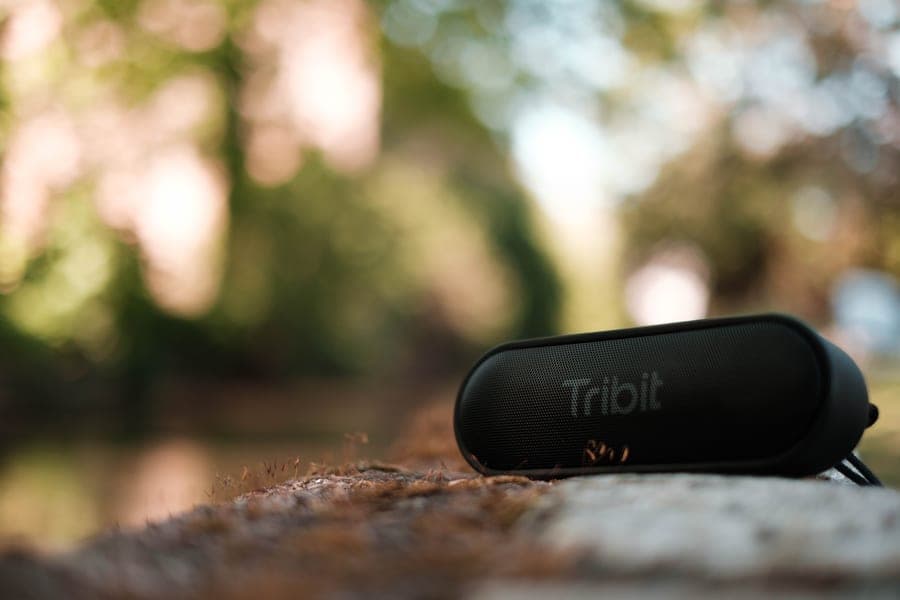 Illustrative
Best for a full day in the cold
JBL Charge 6
The battery-life benchmark, with a power bank built into the back.
- What it does well
- Twenty-four quoted hours, rising to twenty-eight with Playtime Boost, is the headroom this use case needs — lose a third to the cold and it still covers a long day on a hill or on the ice. IP68 is the strongest rating here and the only one certifying dust as well as water, which covers snow, grit and road salt. The built-in power bank is unexpectedly valuable in winter, because the phone feeding the speaker is losing capacity to the same chemistry.
- Where it cuts corners
- It is the most expensive pick here and a chunky cylinder, so it rides in a pack rather than a pocket — which is the wrong place for a battery you want to keep warm. No aux input, and no published drop rating despite the rugged build.
- Who it is for
- Winter camping, ice fishing, a day on the hill, and anywhere a dead speaker at 3 pm would actually matter.
- Battery: 24 hours, or up to 28 hours with Playtime Boost enabled
- Water rating: IP68 — submersible to 1.5 m for 30 minutes, dustproof
#ad — we earn a commission on qualifying purchases. How this is funded
 Illustrative
Best to carry inside a jacket
JBL Flip 7
The default mid-size pick, and the speaker every value brand is trying to undercut.
- What it does well
- At 1.82 lb and a shape that fits a large coat pocket or clips inside a pack, this is the pick you can actually keep warm — which does more for cold-weather runtime than any specification. IP68 covers snow, slush and grit on both axes. The clip-on loop means it can hang inside a bag rather than on the outside, and fourteen hours plus Playtime Boost is a reasonable starting point to lose a third from.
- Where it cuts corners
- Fourteen hours is modest once the cold takes its cut — plan on nine or ten for a hard day. You pay a real brand premium. No aux input, and no published drop rating, which matters more in the cold than in summer.
- Who it is for
- Snowboarding, winter hiking, dog walking and anyone whose speaker travels on their body rather than in a vehicle.
- Battery: 14 hours, plus up to 2 more in Playtime Boost mode
- Water rating: IP68 — submersible to 1.5 m for 30 minutes, dustproof
- Weight: 1.82 lb (about 560 g)
#ad — we earn a commission on qualifying purchases. How this is funded
 Illustrative
Best value for a cold garage or workshop
Anker Soundcore 2
Years old, still sold, still the battery-life champion of the cheap shelf.
- What it does well
- Twenty-four quoted hours from a 5,200 mAh cell is a lot of headroom for very little money, which is the right trade for a speaker that lives somewhere cold and gets used in short bursts. IPX7 handles snow brought in on boots and a wet workbench, and 12 W of stereo is plenty in an enclosed space. At this price, treating it as consumable is a reasonable position — which is the sensible way to think about any battery device kept in an unheated building.
- Where it cuts corners
- No dust rating, which is a real gap in a workshop. No drop rating, and a plain plastic shell that will be more brittle at −10 °C than at 20 °C. It sounds thin if you walk away from it, and BassUp is best left off.
- Who it is for
- An unheated garage, a workshop, a shed, or a second speaker that lives in a cold vehicle.
- Battery: 24 hours
- Water rating: IPX7 — submersible to 1 m for 30 minutes
- Output: 12 W stereo
#ad — we earn a commission on qualifying purchases. How this is funded
Storing a speaker somewhere cold
Short-term cold storage is harmless. A speaker left in a cold garage overnight, or in a car boot through a frosty week, is fine — cold slows the chemical ageing that degrades a lithium cell over time, so in that narrow sense cold storage is better for a battery than warm storage. Heat, not cold, is what permanently destroys capacity, which is why leaving a speaker on a dashboard is a worse idea than leaving it in a snowdrift.
What does cause harm is storing a cell at a full or empty charge for months, and the harm is worse at temperature extremes in either direction. If a speaker is going into a cold garage, a stored RV or a boat for the winter, charge it to roughly half first. That is the single best thing you can do for its lifespan, and it costs nothing. How long Bluetooth speakers last covers the wider picture.
One practical consequence worth planning for: a speaker stored in the cold will not charge until it warms up, and warming up a cold speaker from a garage takes longer than people expect — an hour or more for a large one. If you need it on a winter morning, bring it in the night before.
Practical cold-weather habits
- Carry it inside a layer, not strapped to the outside of a pack. Body heat is free and it is the most effective intervention available.
- Turn the volume down. High current draw is what a cold cell handles worst, so moderate volume buys disproportionately more runtime in winter than in summer.
- Let it warm up before charging. Room temperature, not just "not freezing". If it refuses the charger, that is the protection, not a fault.
- Let it warm up gradually when you bring it in. Leaving it in a closed bag for half an hour avoids condensation forming inside a sealed enclosure.
- Use physical buttons, or set the volume before you put your gloves on.
- Store it at around half charge over winter, and ideally indoors.
If the speaker is going camping in the cold, camping speakers ranks on the battery problem specifically. If it lives in a vehicle, the best speakers for a truck covers the heat-and-cold storage question, and the best speakers for an RV covers winter storage in a stored rig. And if the runtime you are getting seems wrong in any weather, battery life, honestly explains how the quoted figures are produced.
Frequently asked questions
Do Bluetooth speakers work in cold weather?
Will cold weather damage my Bluetooth speaker?
Why won't my speaker charge after being out in the snow?
Why did my speaker's battery drain so fast in the cold?
Is it bad to store a Bluetooth speaker in a cold garage?
What is the best Bluetooth speaker for cold weather?
Update log
- First publication. Separates reversible capacity loss from the permanent damage caused by charging a frozen cell, which is the part that actually matters.
Sources
Every specification quoted above comes from the manufacturer or retailer listing below. We publish no measurements of our own — see how we pick.
- Battery University — how lithium-ion batteries age (BU-808)
- Apple — maximizing battery performance and lifespan
- FAA PackSafe — lithium batteries in carry-on and checked baggage
- JBL — Charge 6 product page (manufacturer specifications)
- JBL — Flip 7 product page (manufacturer specifications)
- Soundcore — Soundcore 2 product page (manufacturer specifications)
- IEC 60529 — the international standard behind IP ratings
Read next
Guides
Bluetooth speaker battery life, honestly
How quoted runtimes are produced, what to expect in reality, and the longest-lasting picks.
Guides
How long do Bluetooth speakers last?
Product lifespan separated from battery runtime — what fails, when, and how to delay it.
Outdoor & Party
The best Bluetooth speakers for camping in 2026
Campsite picks chosen for battery and packability rather than volume — the opposite of a party speaker.

Outdoor & Party
The best Bluetooth speakers for a truck in 2026
Why 24 hours and a strap beat wattage in a cab, and the five speakers that fit the life.
Outdoor & Party
The best Bluetooth speakers for an RV in 2026
Why an RV is the one outdoor case where runtime does not matter, and the five speakers that suit it.

Guides
What IPX7 and IP67 actually mean
Every IP rating decoded, and the single character that decides pool versus beach.