Guides
Can you connect two different brands of Bluetooth speaker?
Almost never, and the reason is not stinginess — it is that the standard everyone used had no way to do it.
By Ryder M.Published
 Field-tested picks · 2026
How we are funded: Thump & Tote earns a commission when you buy through our Amazon links, at no extra cost to you. It never changes which speaker we put first — see how we pick and our affiliate disclosure.
Essentially no, not in the way people mean. Every multi-speaker system on the market — JBL's Auracast and the older PartyBoost, Soundcore's TWS pairing, Ultimate Ears' PartyUp, Bose's party mode — is a proprietary layer the manufacturer built on top of Bluetooth, and those layers do not talk to each other. A JBL will not link to a Soundcore. There are exactly three workarounds: a wired connection if both speakers have an aux jack, a Bluetooth transmitter that broadcasts to two receivers, or Auracast, which is a genuine industry standard and the first real hope of cross-brand linking — but only between speakers that both support it.
The frustration behind this question is reasonable. Bluetooth is a standard; two speakers from different makers both speak it; it seems obvious that they should be able to play the same song. The reason they cannot is historical rather than commercial, and understanding it makes the workarounds make sense.
Why classic Bluetooth cannot do this
The profile that carries music over Bluetooth — A2DP, the one every speaker has used for twenty years — was designed as a point-to-point link. One source, one sink. There is no provision in it for a phone to stream the same audio to two independent devices, and no provision for two speakers to agree on timing with each other. It simply is not a feature of the standard.
That timing point is the one people underestimate. Two speakers playing the same track even a few tens of milliseconds apart do not sound like a stereo pair; they sound like an echo, and the effect is genuinely unpleasant. Any multi-speaker system has to solve synchronisation, and solving it requires the speakers to communicate in a way the base standard never specified.
So every manufacturer invented its own method — a private protocol between its own speakers, with its own clock-sync scheme. Those protocols were never published and were never meant to interoperate. That is why a JBL and a Soundcore sitting next to each other, both Bluetooth 5.4, cannot do the one thing you want.
| System | Brand | Links with |
|---|---|---|
| Auracast | JBL (current models) | Other Auracast devices — including, in principle, other brands |
| PartyBoost | JBL (older models) | Other PartyBoost JBLs only |
| TWS pairing | Soundcore, Tribit and many others | A second identical or same-family unit |
| PartyUp | Ultimate Ears | Other compatible UE speakers only |
| Party mode | Bose | Compatible Bose speakers only |
The three workarounds, ranked
- Auracast, if both speakers have it. The only approach that is a real solution rather than a compromise: proper synchronisation, no cables, no extra hardware. Check the specification sheet of both speakers — the branding varies but the Bluetooth SIG logo does not.
- A cable, if both speakers have aux inputs. A 3.5 mm splitter from one source into two speakers is perfectly synchronised by definition and costs almost nothing. The problem is that aux inputs have become rare — the best speakers with an aux input is a short list for a reason — and you are tethered to a cable run.
- A dual-link Bluetooth transmitter. A small box that plugs into a source's headphone jack or USB and transmits to two Bluetooth receivers at once. It works with any two speakers regardless of brand, which is its whole appeal. The catch is synchronisation: unless the transmitter and both speakers support the same low-latency codec, the two will drift audibly apart, and the echo effect ruins it. Results vary enough that it is a gamble rather than a recommendation.
What does not work, despite being widely suggested: connecting one speaker to your phone and a second speaker to the first. Speakers are endpoints; they do not re-transmit audio. Nor do phone-level dual-audio features reliably solve it — some Android devices offer a dual-audio mode that sends to two sinks, but it is implementation-specific, frequently drops out, and almost always has the timing problem.
Speakers that do this well within a brand
If what you actually want is two speakers playing together, the honest advice is to buy both from the same maker — ideally at the same time. These three cover the sensible ways to do it, and all three are picks elsewhere on the site on their own merits.
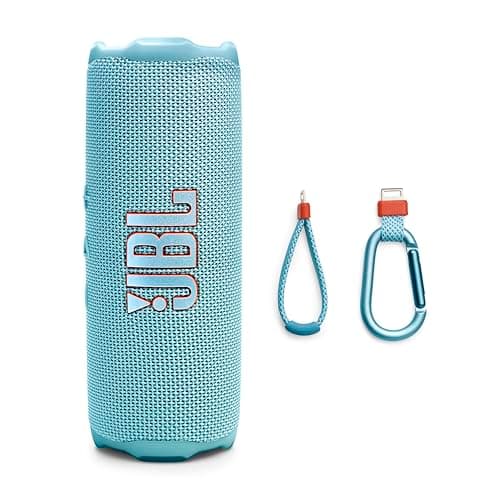
Best Auracast speaker to build around
JBL Flip 7
The default mid-size pick, and the speaker every value brand is trying to undercut.
- What it does well
- Auracast is the whole reason this speaker belongs on this page: it is an industry standard rather than a private protocol, it links speakers without an app dance, and it is the one route that may eventually work across brands. Beyond that it is even-toned across the whole volume range, genuinely rugged at IP68, and USB-C lossless audio removes Bluetooth latency entirely when it is plugged into a computer.
- Where it cuts corners
- You pay a real brand premium — several speakers match its IP rating and beat its 14-hour battery for markedly less. There is no analogue aux input, so the cable workaround on this page is unavailable to it. Older PartyBoost JBLs will not link to it, which catches people out.
- Who it is for
- Anyone buying their first of what will eventually be two or three speakers, who wants to bet on the standard rather than a brand's private system.
- Battery: 14 hours, plus up to 2 more in Playtime Boost mode
- Water rating: IP68 — submersible to 1.5 m for 30 minutes, dustproof
- Weight: 1.82 lb (about 560 g)
#ad — we earn a commission on qualifying purchases. How this is funded · Price as of October 17, 2026
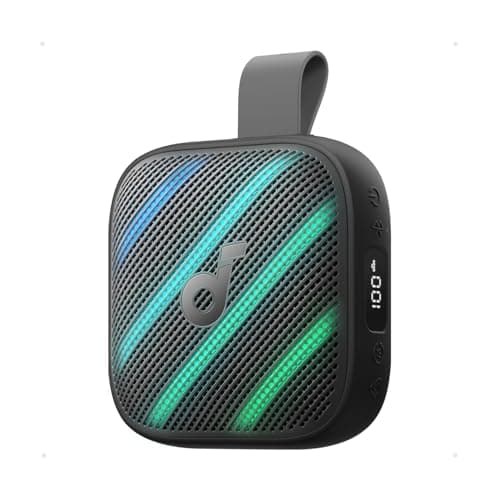
Best value pair, with both systems on board
Soundcore Boom Go 3i
Our default recommendation under $100 — tough, long-running and honestly specified.
- What it does well
- It supports TWS pairing for true stereo across two units *and* Auracast, which is an unusually complete set at this price — two of these make a genuine stereo pair for less than one mid-tier speaker. IP68 dust-tight sealing with a 1 m drop rating is the strongest durability spec on this site, and 24 hours means both halves of a pair last a day.
- Where it cuts corners
- A single unit is mono, which is the whole argument for buying two. Fifteen watts each means a pair covers a room or a patio rather than a yard. The light modes are the fastest way to spend the battery.
- Who it is for
- The value buyer who wants real stereo separation and is willing to buy two cheap speakers instead of one expensive one.
- Battery: 24 hours, with a battery-level display on the speaker
- Water rating: IP68 — submersible and dust-tight, and drop-tested from 3.28 ft (1 m)
- Output: 15 W with BassUp 2.0, quoted at 92 dB peak
- Weight: 0.84 lb
#ad — we earn a commission on qualifying purchases. How this is funded · Price as of October 17, 2026
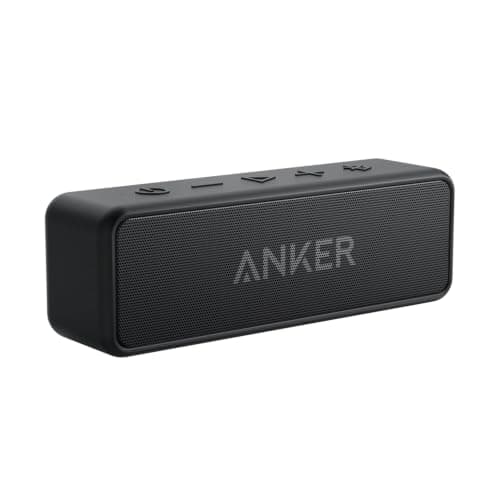
Cheapest way to get a stereo pair
Anker Soundcore 2
Years old, still sold, still the battery-life champion of the cheap shelf.
- What it does well
- Wireless stereo pairing with a second unit, on a speaker that already costs very little — two of these cost less than one mid-tier speaker and sound wider than any single box can. Twenty-four hours each means the pair outlasts almost anything, and 12 W of stereo per unit is generous at the price.
- Where it cuts corners
- The design is visibly dated and the treble is soft compared with anything recent. There is no dust rating. BassUp adds thump at the cost of clarity, and a pair of cheap speakers will not match one good one for refinement — only for width.
- Who it is for
- Anyone whose real goal is stereo separation on a budget, rather than linking two speakers they already own.
- Battery: 24 hours
- Water rating: IPX7 — submersible to 1 m for 30 minutes
- Output: 12 W stereo
#ad — we earn a commission on qualifying purchases. How this is funded · Price as of October 17, 2026
Buy the pair together
The single most useful piece of advice on this page: if you think you will eventually want two speakers, buy both at once, from the same maker, in the same generation. Pairing frequently fails even within a brand across generations — JBL's move from PartyBoost to Auracast is the clearest recent example, and a PartyBoost speaker will not link to an Auracast one despite both being JBL.
If you already own one speaker and want a second, check what linking system the one you have uses before buying anything, and buy a model that explicitly lists the same one. How to pair two Bluetooth speakers has the per-platform steps once you have two compatible units, and how many you can connect at once covers the ceiling.
Do you actually want two speakers?
Two cases justify it clearly. The first is covering a long space — a yard, a deck, a two-room apartment — where two speakers at opposite ends beat one loud speaker in the middle, because nobody is deafened and nobody is straining. The second is stereo separation in a listening space, which is only perceptible if the speakers are a reasonable distance apart and you are between them.
The case that does not justify it is volume. Two speakers are not twice as loud as one — doubling the number of sources adds a few decibels, which is much less than doubling. If loudness is the goal, one bigger speaker is both cheaper and better: the loudest Bluetooth speakers for the money is the page, and mono vs stereo covers when separation is genuinely worth paying for.
Frequently asked questions
Can you connect two different brands of Bluetooth speaker together?
Can you connect two different JBL speakers?
Why can't two Bluetooth speakers play the same music?
Will a Bluetooth transmitter let me use two different speakers?
Can I connect one speaker to another speaker?
Is Auracast going to fix this?
Update log
- First publication. Separates the cross-brand question from the same-brand how-to, which the existing pairing guide covers.
Sources
Every specification quoted above comes from the manufacturer or retailer listing below. We publish no measurements of our own — see how we pick.
- Bluetooth SIG — Auracast and Bluetooth LE Audio
- Bluetooth SIG — Bluetooth technology overview (profiles, codecs, LE Audio)
- SoundGuys — Goodbye JBL PartyBoost, hello Auracast
- JBL — Flip 7 product page (manufacturer specifications)
- Soundcore — Boom Go 3i product page (manufacturer specifications)
- Soundcore — Soundcore 2 product page (manufacturer specifications)
- Apple — connect Bluetooth accessories to iPhone
- Android Help — connect to Bluetooth devices
Read next
Guides
How to pair two Bluetooth speakers
Platform-by-platform steps for stereo and multi-speaker pairing — and why cross-brand does not work.
Guides
How many Bluetooth speakers can you connect at once?
The real limits on multi-speaker Bluetooth, the four routes past one, and what each one costs you.
Head-to-Head
Auracast vs PartyBoost: what JBL changed
Which JBL speakers link with which, the single model that bridges both, and the cheaper way to get stereo.
Head-to-Head
Mono vs stereo Bluetooth speakers
When stereo separation is audible, when it is marketing, and the four speakers that handle each case.
By Price
The best Bluetooth speakers with an aux input in 2026
Speakers that kept the 3.5 mm jack, and the three jobs it does that Bluetooth cannot.
Outdoor & Party
The loudest Bluetooth speakers for the money in 2026
Genuinely loud speakers ranked on output per dollar — and why wattage figures cannot be compared.