Reviews
Tribit StormBox Blast review
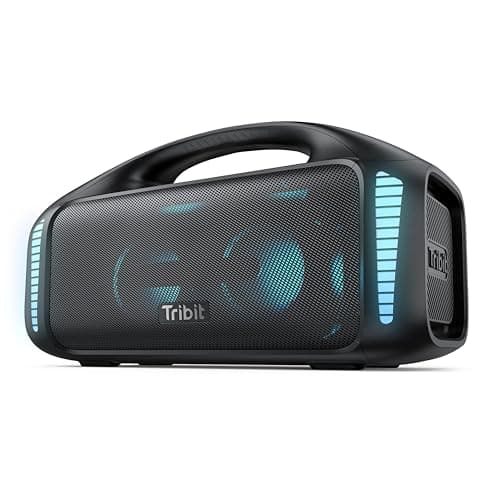
This is the speaker this site reaches for whenever the answer is simply "more output per dollar". It earns that, and it asks for eleven and a half pounds of your cooperation.
By Ryder M.Published
 Field-tested picks · 2026
How we are funded: Thump & Tote earns a commission when you buy through our Amazon links, at no extra cost to you. It never changes which speaker we put first — see how we pick and our affiliate disclosure.
The Tribit StormBox Blast is a 90 W boombox-format speaker — Tribit's listing also quotes a 140 W peak figure — built around two 11 cm bass-midrange drivers, two 3 cm tweeters and two passive radiators on the sides. Tribit quotes 30 hours of playtime from a 71.28 Wh (10.8 V / 6600 mAh) pack with a 4.5-hour charge; RTINGS measured 32.1 hours, which is longer than the claim. It is IPX7, runs Bluetooth 5.3, and it is one of very few speakers at this money with a 3.5 mm aux input and a USB-A port that charges your phone. It weighs 11.6 lb (about 5.4 kg) and measures 16 x 6.4 x 8.9 in. There is no microphone input. For open-air volume per dollar, nothing else we cover gets close; for anything you have to carry far, it is the wrong speaker.
This speaker turns up more often on this site than any other product, and not because it is the best thing we recommend. It turns up because the honest answer to a whole family of questions — a tailgate, a backyard, a baseball field, an outdoor movie night, a driveway party — is "you need a bigger cabinet than you think, and here is the cheapest one that does not sound bad." That is the StormBox Blast's entire job. This page is the one place we set out what the speaker actually is, including the parts the roundups only get a sentence for.
Every figure below is either Tribit's own published specification or an independent measurement we attribute to whoever took it. Nothing on this page is measured by us, and we have not opened one up. How we pick sets out the method and its limits.
What it does well
It gets genuinely loud, and it does it with cabinet volume rather than processing. RTINGS measured 96.7 dB SPL at maximum volume. That is a figure worth sitting with: it is loud enough that outdoors, with no walls to help, a group of twenty people can hold a conversation over it and still hear the music clearly. The reason is the driver layout, not a wattage number. Two 11 cm bass-midrange cones plus two side-firing passive radiators move far more air than the 50 to 80 W compact speakers this site usually recommends, and air movement is what low frequencies actually are. Watts and loudness explains why the published wattage tells you so much less than people assume.
The battery beats its own claim, which almost never happens. Tribit quotes 30 hours. RTINGS measured 32.1. Manufacturer battery figures in this category are normally measured at half volume with every power-hungry feature off, and real-world results come in well under. Here the independent number is higher than the marketing one. In practical terms this is a speaker you charge on a schedule rather than a speaker you worry about — a full tournament weekend, a two-day festival campsite, a long tailgate and the drive home. How long portable speakers last covers why quoted and measured runtimes usually diverge in the other direction.
There is a 3.5 mm aux input, and that is rarer than it should be. Almost every mainstream portable has dropped the analog jack; JBL has not shipped one on a Flip, Charge or Xtreme in years. A wire matters in three specific situations: a projector or a TV, where Bluetooth latency puts the audio behind the picture; a turntable or a mixer, which has no Bluetooth to give; and a shared device, where handing over a cable is faster than re-pairing. The Blast is this site's value answer in all three — see speakers with an aux input, connect a Bluetooth speaker to a TV and the best speaker for an outdoor movie night.
The USB-A port works as a power bank. StereoGuide's hands-on confirms the speaker will charge a phone from that port while it is playing, over Bluetooth or over the aux input. Tribit does not publish an output figure for it, so treat it as a top-up rather than a fast charge. On a day out with no socket, a 71.28 Wh battery sitting next to a dying phone is a genuinely useful thing to own.
The app is better than the price suggests. StereoGuide lists seven presets — Music, XBass, Audiobook, Classical, Jazz, Party and Rock — plus a 9-band custom equalizer with saveable settings, along with auto-shutdown control and over-the-air firmware updates. Nine bands is more adjustment than most premium speakers offer, and it matters here: the factory tuning leans warm, and pulling the low end down two or three dB is the single best thing you can do to this speaker indoors. Why cheap speakers sound cheap is the longer version of that argument.
IPX7 means a sealed body, not a splash guard. IPX7 is the standard's immersion test — thirty minutes under a meter of water. For a speaker this size that is less about dropping it in a pool and more about rain at a tailgate, a hose at the end of a dusty afternoon, and the sprinkler nobody accounted for. Note the X: Tribit publishes no dust rating, which is the one gap in the sealing story. What IPX7 and IP67 actually mean is the primer.
The controls are designed for a party, not a spec sheet. Large illuminated keys on the top handle volume, playback, the lights and XBass, so somebody who has never seen the speaker before can find the volume in the dark without asking. The 32-LED array reacts to the music, and there is a dedicated key to switch it off rather than an app dive. The carry handle runs the width of the body and both reviewers who handled it called the build solid.
Where it cuts corners
11.6 lb is the headline compromise, and the one most listings bury. This is a speaker you deliver somewhere. It goes in a car and comes out at the destination; it does not go in a backpack, on a bike, or up a trail. StereoGuide's stated criticism is exactly this — the weight restricts mobility. If your use case involves carrying the speaker while it plays, stop reading this page and go to the best speakers for travel or the best for hiking instead.
The bass loses precision when you push it hard, especially with XBass on. StereoGuide names this directly, and RTINGS' measurement puts a number on the mechanism: 3.89 dB of dynamic range compression at maximum volume. The speaker is protecting itself, which is the right behavior — but it means the last fifteen percent of the volume dial buys you loudness rather than quality. The practical fix is free: turn XBass off before you turn the volume to the top, not after. You will get a cleaner result at the same perceived level.
There is no microphone input of any kind. The Blast is marketed as a party speaker and a great many buyers assume that includes a mic. It does not, and no amount of app configuration adds one — a phone's Bluetooth microphone profile cannot be routed back out of a speaker that is receiving A2DP audio. If somebody needs to make a toast, call a line-up or sing, the JBL PartyBox Encore Essential 2 is the pick instead, and speakers with a microphone input explains how narrow that category really is.
The lights are the fastest way to spend the battery. StereoGuide's reviewer notes the 30-hour claim is much less realistic with the light show running, and the 32.1-hour independent result will have been measured without it. The dedicated off key exists for a reason. Lights are genuinely fun for the first hour of a party and nobody looks at them for the remaining five. Speakers with lights is the honest version of this across the category.
The app wants an email address. StereoGuide reports that full app functionality requires email registration. For a 9-band EQ that is a trade some people will decline, and the speaker is perfectly usable without the app — you just lose the custom EQ, the auto-shutdown setting and firmware updates. It is worth knowing before you buy, because the EQ is one of the better reasons to choose this speaker.
Charging takes 4.5 hours and the box is sparse. Tribit quotes a 4.5-hour charge, and The Gadgeteer's spec listing confirms the box contains the speaker, a charging cable and a manual. There is no case and no aux cable, which is a small irritation given that the aux input is one of the speaker's selling points. On a 71.28 Wh pack, 4.5 hours is reasonable rather than impressive.
Fit and finish trails the big brands, and it shows where you touch it. Nobody who has handled a Blast and an Xtreme 4 back to back would mistake one for the other. The Tribit's plastics and grille feel like what they are. That is the deal you are making, and on this site we think it is a good deal — but a speaker that costs a fraction of a flagship is not secretly a flagship. Is JBL worth it works through what the premium actually buys.
It is the older model in its own line. Tribit has since shipped a StormBox Blast 2. We cover the original because it is the one whose value proposition we can stand behind, it is live and priced, and it is the model with a measurement record. If you see the newer one discounted to the same money, it is worth comparing — but do not assume a higher wattage figure on a different cabinet means more usable output. How to choose a Bluetooth speaker is the framework for that.
Specifications
| Specification | Figure |
|---|---|
| Rated output | 90 W (the listing also quotes a 140 W peak figure) |
| Drivers | 2 x 11 cm bass-midrange, 2 x 3 cm tweeters, 2 passive side radiators (StereoGuide) |
| Quoted playtime | 30 hours |
| Measured playtime (RTINGS) | 32.1 hours |
| Maximum SPL (RTINGS) | 96.7 dB, with 3.89 dB of dynamic range compression |
| Battery | 71.28 Wh (10.8 V / 6600 mAh) |
| Charge time | 4.5 hours |
| Bluetooth | 5.3, with a quoted 164 ft (30 m) range |
| Water and dust | IPX7 — submersible to 1 m for 30 minutes. No dust rating published |
| Wired audio input | 3.5 mm aux in |
| Charge out | USB-A power bank output; no figure published |
| Lighting | 32 LEDs, music-reactive, with a dedicated off key |
| App | 7 presets plus a 9-band custom EQ, auto-shutdown, OTA firmware. Email registration required for full function |
| Microphone input | None |
| Dimensions | 16 x 6.4 x 8.9 in (40.5 x 16.3 x 22.6 cm) |
| Weight | 11.6 lb (about 5.4 kg) |
| In the box | Speaker, charging cable, user manual |
How it compares
The StormBox Blast itself, summarized
Tribit StormBox Blast
The loudest thing we are willing to call good value.
- What it does well
- Measured 96.7 dB of output and 32.1 hours of battery, a 3.5 mm aux input, a USB-A port that charges a phone, a 9-band app EQ with seven presets, IPX7 sealing, controls a stranger can operate in the dark, and a 32-LED show you can switch off with one key.
- Where it cuts corners
- 11.6 lb, bass that softens under 3.89 dB of compression at the top of the dial, no microphone input, no dust rating, a 4.5-hour charge, an app that wants an email address, and plastics that do not feel like the brands it undercuts.
- Who it is for
- Open ground with a group on it, reached by car — tailgates, backyards, fields and driveways.
- Battery: Over 32 hours in independent testing
- Water rating: IPX7 — submersible to 1 m for 30 minutes
#ad — we earn a commission on qualifying purchases. How this is funded · Price as of November 11, 2026
The one most people should buy instead
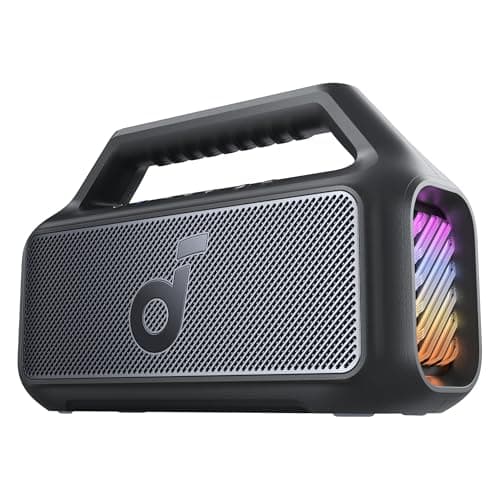
Soundcore Boom 2
The value answer to a party speaker: it floats, it is loud, and it lasts a day.
- What it does well
- A dedicated 50 W subwoofer plus two 15 W tweeters, so the low end comes from hardware rather than EQ, a carry strap instead of a handle, and it floats. It is markedly lighter and cheaper than the Blast and it covers a backyard perfectly well.
- Where it cuts corners
- No aux input at all, so a projector or a turntable rules it out, and the quoted 24 hours assumes BassUp and the lights are off. It does not have the Blast's raw headroom in genuinely open air.
- Who it is for
- Backyards, pools and tailgates for a normal-sized group — which is most people, most of the time.
- Battery: Up to 24 hours at 50% volume with BassUp and lights off
- Water rating: IPX7 — submersible to 1 m for 30 minutes, and it floats
- Output: Up to 80 W peak output (a 50 W subwoofer plus two 15 W tweeters)
#ad — we earn a commission on qualifying purchases. How this is funded · Price as of November 11, 2026
If anybody needs a microphone
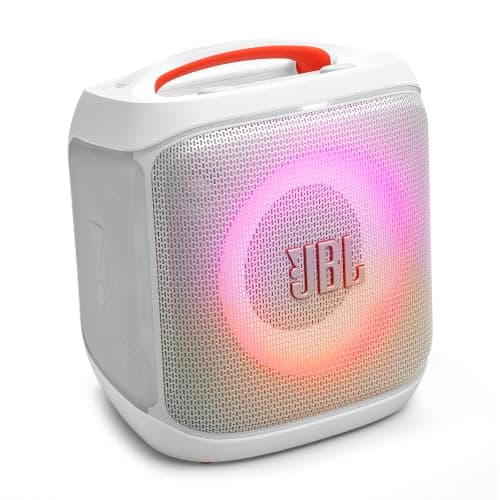
JBL PartyBox Encore Essential 2
The cheapest genuinely portable speaker here with a real microphone input.
- What it does well
- A real 3.5 mm mic input at 20 mV RMS with a karaoke EQ behind it, a guitar input beside it, a 370 mV RMS aux input, 100 W RMS measured to the stricter IEC60268 standard, and Auracast to pair two of them.
- Where it cuts corners
- IPX4 is splash resistance only — no immersion, no dust rating, so this one does not go to the beach. Fifteen hours is half the Blast's battery, it weighs more at 13.67 lb, and no microphone is included despite the mic input being the reason to buy it.
- Who it is for
- Karaoke, toasts, announcements, coaching and teaching — anywhere a voice has to go through the speaker.
- Battery: Up to 15 hours
- Water rating: IPX4 — splash-resistant only. Not submersible, no dust rating
- Output: 100 W RMS (IEC60268)
#ad — we earn a commission on qualifying purchases. How this is funded · Price as of November 11, 2026
If you want the brand-built version
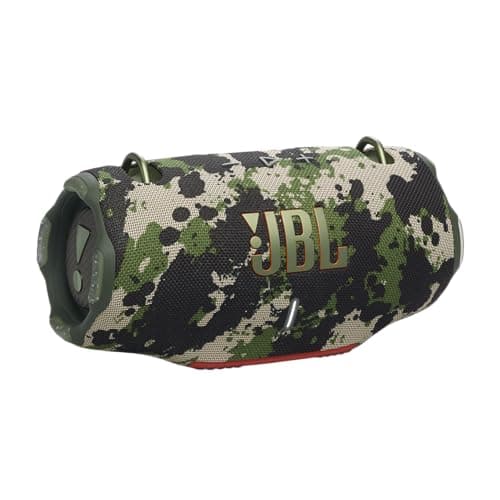
JBL Xtreme 4
Two woofers and two bass radiators — the most convincing low end JBL puts in a carryable box.
- What it does well
- Two 70 mm woofers and two bass radiators in a sealed IP67 body at 4.63 lb — less than half the Blast's weight — with a user-replaceable battery, 24 hours plus 6 in Playtime Boost, a power bank and Auracast. The build quality is in a different class and so is the resale value.
- Where it cuts corners
- It costs several times what the Blast does, it has no aux input and no microphone input, and in genuinely open air with a crowd it has less cabinet to work with. The outgoing generation now that the Xtreme 5 has shipped, so stock will thin.
- Who it is for
- Buyers who will carry the speaker regularly and want it to last through several seasons of abuse.
- Battery: Up to 24 hours, plus 6 more with Playtime Boost
- Water rating: IP67 — submersible to 1 m for 30 minutes, dustproof
- Output: Two 70 mm woofers and two 20 mm tweeters with dual bass radiators
- Weight: 4.63 lb (2.1 kg)
#ad — we earn a commission on qualifying purchases. How this is funded · Price as of November 11, 2026
Who should skip it
- Anyone who has to carry it. 11.6 lb is a two-hand, one-trip speaker. The best small Bluetooth speakers is the honest alternative.
- Anyone who needs a microphone. There is no input for one. Speakers with a microphone input is the short list that does.
- Anyone listening at low volume indoors. This cabinet wants to be played. In a bedroom it is wasted and overbearing — the best speaker for a bedroom is built around the opposite requirement.
- Anyone who needs a dust rating. IPX7 has no dust figure behind it. The best speakers for a jobsite covers IP6X-rated options.
- Anyone buying for a pool. It is submersible but Tribit does not claim it floats. Waterproof speakers that float covers the ones that do.
If this is the right size but you are not sure it is the right brand, the loudest for the money ranks the whole category on output per dollar and the best outdoor party speakers is the full roundup this speaker tops. If you are not sure about the size at all, what size speaker do I need is the page that settles it before you spend.
Frequently asked questions
How long does the Tribit StormBox Blast battery really last?
How loud is the Tribit StormBox Blast?
Does the Tribit StormBox Blast have an aux input?
Can the Tribit StormBox Blast charge a phone?
Does the Tribit StormBox Blast support a microphone?
Is the Tribit StormBox Blast waterproof?
How much does the Tribit StormBox Blast weigh?
Should I buy the StormBox Blast or the StormBox Blast 2?
Update log
- First publication. The site has recommended this speaker on a dozen pages for months without a page of its own; this one records the full specification, including the 11.6 lb weight and the 3.89 dB of compression at maximum volume that the roundups only had room to summarize.
Sources
Every specification quoted above comes from the manufacturer or retailer listing below. We publish no measurements of our own — see how we pick.
- Tribit — StormBox Blast product page (manufacturer specifications)
- RTINGS — Tribit StormBox Blast measurements (independent test lab)
- The Gadgeteer — Tribit StormBox Blast review (published specification table)
- StereoGuide — Tribit StormBox Blast review (independent hands-on)
- JBL — PartyBox Encore Essential 2 specification sheet (PDF, manufacturer specifications)
- IEC 60529 — the international standard behind IP ratings
- Battery University — how lithium-ion batteries age (BU-808)
Read next
Outdoor & Party
The best Bluetooth party speakers in 2026
The four features that make a speaker a party speaker, and the five that genuinely have them.
Outdoor & Party
The loudest Bluetooth speakers for the money in 2026
Genuinely loud speakers ranked on output per dollar — and why wattage figures cannot be compared.
Outdoor & Party
The best Bluetooth speakers for tailgating in 2026
Parking-lot speakers that stay audible — and the battery arithmetic to do before you buy.
By Price
The best Bluetooth speakers with an aux input in 2026
Speakers that kept the 3.5 mm jack, and the three jobs it does that Bluetooth cannot.
Reviews
JBL PartyBox Encore Essential 2 review
Mic in, guitar in, aux in and 15 hours off the battery — against IPX4 and 13.67 lb.
Reviews
Party-class bass hardware for the money — and the battery claim that needs translating.
Outdoor & Party
The best Bluetooth speaker for fitness classes
Why a class is a voice problem before it is a volume problem, and the five speakers that get an instructor through a day.