Reviews
Bose SoundLink Max review
Far above this site's usual ceiling, and worth writing about anyway — because of one port on the back that the entire category has abandoned.
By Ryder M.Published
 Field-tested picks · 2026
How we are funded: Thump & Tote earns a commission when you buy through our Amazon links, at no extra cost to you. It never changes which speaker we put first — see how we pick and our affiliate disclosure.
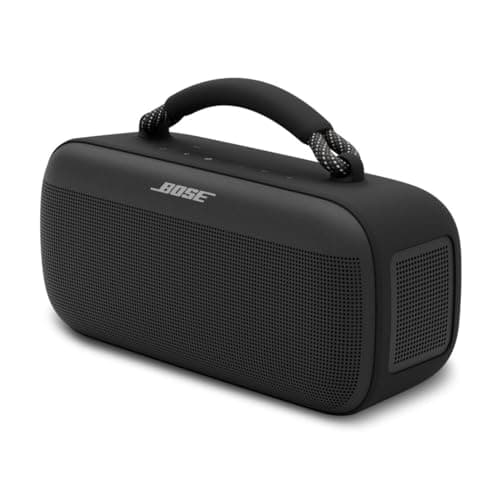
The Bose SoundLink Max is a 4.9 lb portable built around Bose's Articulated Array — two 89 mm transducers and one 23 mm transducer across the front, with two 104 x 79 mm racetrack passive radiators at the ends. Bose quotes up to 20 hours of playtime from a 5-hour charge, IP67 sealing, Bluetooth 5.4 with aptX Adaptive over Snapdragon Sound and multipoint, a 3.5 mm aux input, USB-C audio in and power out, and a removable rope handle. Independent measurement by RTINGS puts it at 95.7 dB maximum SPL with 2.55 dB of compression at that level, with a soundstage score of 7.8 and a directivity index of 4.23 dB. There is no microphone, so no calls and no voice assistant, and it lists several times above this site's usual ceiling — the live price is on the buy row above.
We review it anyway for one reason, and it is not the sound. The SoundLink Max still has a 3.5 mm input, and in 2026 that is close to extinct on a portable speaker. The JBL Flip 7, the Charge 6, the Xtreme 4, the Marshall Emberton III and Bose's own SoundLink Flex have all dropped it. If you have a turntable, a TV, a mixer or an older source, that single port decides the purchase before any of the audio does.
Everything else here is written from the value buyer's chair, which means being blunt about a speaker in this bracket on a site whose whole argument is that most people overspend on portables. The short version: the sound is genuinely a class above anything cheaper we cover, and almost nobody needs it to be.
What it does well
It keeps the aux jack. A 3.5 mm input is a wired, zero-latency, pairing-free connection to literally anything with a headphone socket. It removes the Bluetooth delay that makes video unwatchable, it works when a phone's battery is dead, and it is the only way to feed a speaker from a record player without buying a transmitter. The category abandoned it to save a hole in a waterproof shell; Bose kept it inside an IP67 body, which is the harder engineering. Speakers with an aux input is the full list of what is left.
The driver layout is a real stereo arrangement, not a marketing one. Three transducers across the front and two racetrack passive radiators at the ends is more hardware than any portable in this site's usual price band carries, and RTINGS' measured directivity index of 4.23 dB with a 7.8 soundstage score reflects it. The practical effect is that voices sit forward and distinct rather than being pushed behind the bass — the thing cheap speakers almost always get wrong. Best sound quality for the money is where that stacks up against cheaper options.
It holds together at maximum volume. 2.55 dB of compression at 95.7 dB SPL is a small amount of squeeze at a genuinely loud level. Most portables protect themselves much more aggressively as they approach their ceiling, which is why they get loud and simultaneously get worse. This one largely does not. How many watts is loud explains why that measurement tells you more than any wattage number.
aptX Adaptive, multipoint and a USB-C audio path. Bluetooth 5.4 with aptX Adaptive over Snapdragon Sound gives Android users a higher-bandwidth link than the SBC-only speakers in this bracket; multipoint holds two devices at once; and USB-C carries audio as well as charging a phone from the speaker's own battery. That is three wired or near-wired paths on a speaker most rivals ship with one.
IP67 with a removable rope handle. Submersible to 1 m for 30 minutes with a tested dust seal, in an aluminum-and-fabric body that is clearly built to be carried rather than merely survived. The rope handle comes off; a shoulder strap is a separate purchase, which is worth knowing before the box arrives.
The Bose app includes an adjustable EQ. Three-band adjustment plus presets means you can pull the factory bass lift down, which — see below — you will probably want to. A surprising number of premium speakers still ship with no tone control at all.
Where it cuts corners
The price is the headline problem, and it is not close. This site's position is that the $50-to-$100 band covers most people's actual requirements, and the SoundLink Max sits several times above the top of it. Reviewers make the same point from the other direction: at this money, Wi-Fi speakers with AirPlay and voice control are available, and the Max has neither. You are paying for sound and build, nothing else. Is JBL worth it is the same argument applied to the brand premium everybody knows better.
4.9 lb, and that is portable the way a toolbox is portable. It moves from room to room and it goes in a car. It does not go in a suitcase without consequences, and reviewers consistently flag the weight as the reason not to travel with it. The best speakers for travel ranks on exactly the axis this speaker loses on.
There is no microphone at all. No speakerphone, no voice assistant, no hands-free anything. Most speakers in this bracket include at least a mediocre mic; the Max includes none. If you expected to take a call on it, that is a hard no rather than a disappointment.
Bluetooth only — no Wi-Fi, no AirPlay, no streaming service built in. At this price that absence is conspicuous. A Wi-Fi speaker at the same price streams at higher quality, works across a house and takes voice commands. Bose sells SimpleSync and stereo pairing with a second Max instead, which is useful and is not the same thing. Bluetooth vs Wi-Fi speakers covers the trade properly.
Twenty hours is beaten by speakers costing a quarter as much, and the 5-hour charge is slow. The Marshall Emberton III quotes 32+ hours and charges fully in two; the Anker Soundcore 2 quotes 24 for under $50. Twenty hours is plenty in absolute terms, but it is not a thing this speaker wins on, and five hours on the cable is the slowest recharge of anything we cover.
Out of the box it is bass-heavy. Reviewers describe the default tuning as noticeably bassy, which is a deliberate choice for a speaker sold on impact and a poor one if you want neutrality. The app EQ fixes it in about thirty seconds, but a speaker at this money arriving with its thumb on the scale is worth saying out loud.
The shoulder strap is sold separately. On a 4.9 lb speaker whose rope handle is a single grab loop, that is a conspicuous unbundling at this price.
Specifications
| Specification | Figure |
|---|---|
| Driver layout | Two 89 mm transducers, one 23 mm transducer (Bose Articulated Array) |
| Passive radiators | Two 104 x 79 mm racetrack radiators |
| Battery | Up to 20 hours |
| Charge time | About 5 hours over USB-C |
| Measured max SPL (RTINGS) | 95.7 dB |
| Compression at max volume (RTINGS) | 2.55 dB |
| Soundstage score / directivity (RTINGS) | 7.8 / 4.23 dB |
| Water and dust | IP67 — submersible to 1 m for 30 minutes, dustproof |
| Weight | 4.9 lb |
| Dimensions | 4.73 x 10.42 x 4.13 in |
| Bluetooth | 5.4, with aptX Adaptive over Snapdragon Sound, multipoint |
| Wired input | 3.5 mm aux, plus USB-C audio in |
| Power out | Yes — USB-C charges a phone |
| Microphone | None |
| Carry | Removable rope handle; shoulder strap sold separately |
Alternatives worth knowing about
The SoundLink Max itself, summarized
Bose SoundLink Max
The best-sounding portable we know of, and the one that still has an aux jack.
- What it does well
- Three front transducers and two racetrack passive radiators, 95.7 dB measured with only 2.55 dB of compression, IP67, 20 hours, Bluetooth 5.4 with aptX Adaptive and multipoint, USB-C audio and power out — and a 3.5 mm aux input that almost nothing else in the category still has.
- Where it cuts corners
- A price several times this site's usual ceiling with no Wi-Fi or AirPlay to show for it, 4.9 lb, no microphone of any kind, a slow 5-hour recharge, a bass-heavy default tuning, and a shoulder strap sold separately.
- Who it is for
- Listeners who want the best portable sound we cover, and anyone whose source needs a cable.
- Battery: Up to 20 hours, with a 5-hour full charge
- Water rating: IP67 — submersible to 1 m for 30 minutes, dustproof
- Output: Bose Articulated Array — two 89 mm transducers and one 23 mm transducer, plus two 104 x 79 mm racetrack passive radiators
- Weight: 4.9 lb
#ad — we earn a commission on qualifying purchases. How this is funded · Price as of October 23, 2026
If it has to live outdoors
JBL Xtreme 4
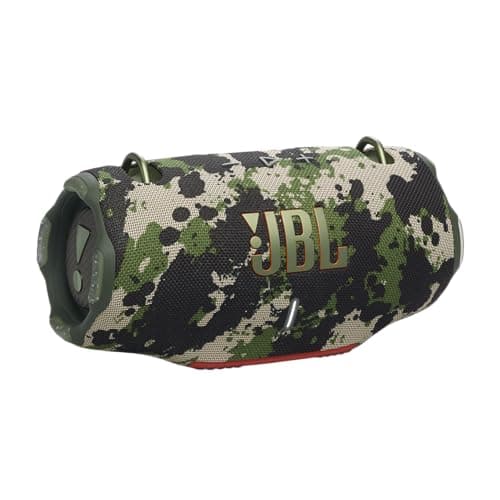
Two woofers and two bass radiators — the most convincing low end JBL puts in a carryable box.
- What it does well
- Four drivers on four amplifier channels with a 44 Hz floor, IP67 on both axes, 24 hours plus 6 more in Playtime Boost, a built-in power bank, a 3.5-hour charge, and the only user-replaceable battery in JBL's portable range — which is the single best reason to own one for years.
- Where it cuts corners
- 2.1 kg on a shoulder strap with no rigid handle, a stereo image reviewers describe as almost mono, SBC-only Bluetooth, no aux input, no NFC and audible compression at the top of its range. It is also now the outgoing generation.
- Who it is for
- Open ground, and anyone who wants a speaker they can keep alive past the battery's first life.
- Battery: Up to 24 hours, plus 6 more with Playtime Boost
- Water rating: IP67 — submersible to 1 m for 30 minutes, dustproof
- Output: Two 70 mm woofers and two 20 mm tweeters with dual bass radiators
- Weight: 4.63 lb (2.1 kg)
#ad — we earn a commission on qualifying purchases. How this is funded · Price as of October 23, 2026
If you want the aux jack without the Bose price
Soundcore Boom 2 Plus
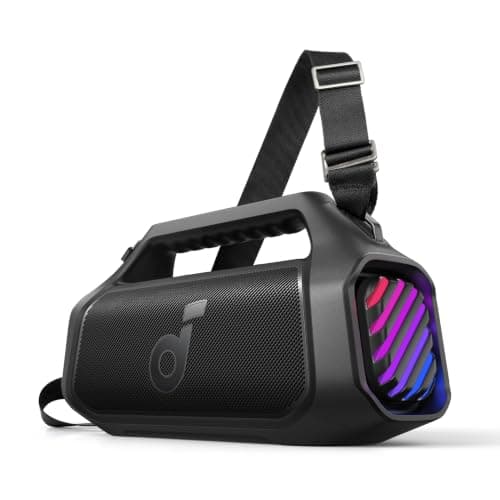
Two woofers, two tweeters and an aux jack — the most bass hardware per dollar in a carryable box.
- What it does well
- Four drivers and a quoted 40 Hz floor — lower than anything else here — plus buoyancy, a 3.5 mm aux input, a 10 W USB output and RGB lighting, at a fraction of the Max's price. The most bass hardware per dollar of anything we cover, and it keeps the port that matters.
- Where it cuts corners
- 8.4 lb, which is heavier again than the Bose. The default BassUp tuning puts the mids and highs behind the bass, the 20-hour figure assumes BassUp and the lights are off, there is a single USB-C port, and IPX7 leaves dust untested.
- Who it is for
- A deck, a patio or a driveway where the speaker stays put, the bass is the point and a wire is still required.
- Battery: Up to 20 hours at 50% volume with BassUp and the light effects switched off
- Water rating: IPX7 — submersible to 1 m for 30 minutes, and it floats
- Output: 100 W as standard, up to 140 W in BassUp 2.0 mode, from two 50 W woofers and two 20 W tweeters
- Weight: 8.4 lb
#ad — we earn a commission on qualifying purchases. How this is funded · Price as of October 23, 2026
If you want Bose tuning at a sane price
Bose SoundLink Flex (2nd Gen)
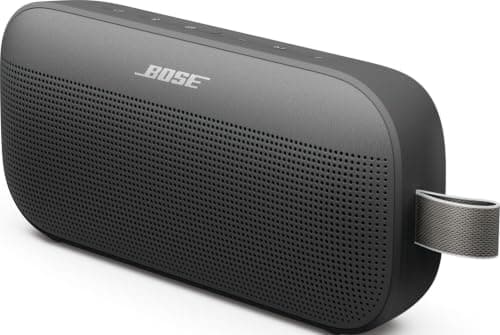
The premium benchmark on this site — included so you can see what the money buys.
- What it does well
- The same voicing philosophy in a 1.3 lb body you can genuinely carry, IP67, a silicone shell that wipes clean, and the most even tuning in its class at low volume. For most people this is the Bose to buy, and it costs a fraction of the Max.
- Where it cuts corners
- Up to twelve hours, which is the shortest battery we recommend at any price, no aux input at all, no USB audio, and it is still expensive for its size and output. It will not fill a room the way the Max does.
- Who it is for
- Desks, kitchens and travel — anyone who wants Bose's sound signature and will never need the Max's scale.
- Battery: Up to 12 hours
- Water rating: IP67 — submersible to 1 m for 30 minutes, dustproof
#ad — we earn a commission on qualifying purchases. How this is funded · Price as of October 23, 2026
Who should skip it
- Almost everyone shopping on value. The same money buys several very good speakers from the under $100 list, and most people cannot articulate what the extra ones are missing.
- Anyone who needs calls or a voice assistant. There is no microphone. Not a weak one — none.
- Anyone who wants Wi-Fi or AirPlay. Bluetooth only, at a price where Wi-Fi speakers are plentiful. Bluetooth vs Wi-Fi speakers is the honest comparison.
- Anyone packing light. 4.9 lb. The best speakers for travel is the right list.
- Anyone buying mainly for battery. Twenty hours is beaten by much cheaper speakers; see battery life.
If the aux jack is what brought you here, read speakers with an aux input before you commit — there are cheaper ways to keep a cable. If the sound is what brought you here, best sound quality for the money sets out where the curve flattens, and why cheap speakers sound cheap explains what you are actually paying to fix.
Frequently asked questions
Does the Bose SoundLink Max have an aux input?
How loud is the Bose SoundLink Max?
How long does the Bose SoundLink Max battery last?
Does the Bose SoundLink Max have a microphone?
Is the Bose SoundLink Max waterproof?
Is the Bose SoundLink Max worth the money?
Can you pair two Bose SoundLink Max speakers?
Update log
- First publication. Driver layout and every published figure captured from Bose's own current listing; the 95.7 dB maximum, 2.55 dB compression and soundstage figures are attributed to RTINGS' independent measurements rather than claimed as ours.
Sources
Every specification quoted above comes from the manufacturer or retailer listing below. We publish no measurements of our own — see how we pick.
- Bose — SoundLink Max product page (manufacturer specifications)
- RTINGS — Bose SoundLink Max review (independent measurements: max SPL, compression, soundstage)
- What Hi-Fi? — Bose SoundLink Max review
- TechRadar — Bose SoundLink Max review
- Bose — SoundLink Flex (2nd Gen) product page
- JBL — Xtreme 4 specification sheet (PDF)
- Soundcore — Boom 2 Plus product page (manufacturer specifications)
- IEC 60529 — the international standard behind IP ratings
- Bluetooth SIG — Auracast and Bluetooth LE Audio
Read next
Reviews
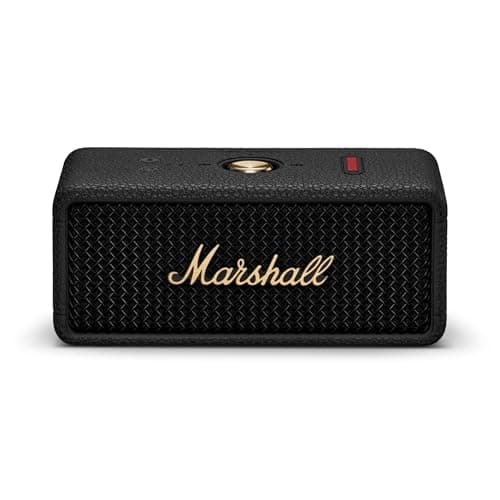
Thirty-two hours from something that fits a coat pocket — and the three specs Marshall does not put on the box.
Reviews
Bose SoundLink Flex (2nd Gen) review
The premium reference point — what careful tuning genuinely buys and where it stops mattering.
By Price
The best Bluetooth speakers with an aux input in 2026
Speakers that kept the 3.5 mm jack, and the three jobs it does that Bluetooth cannot.
By Price
The best sounding Bluetooth speakers in 2026
Ranked on tonal accuracy rather than loudness, with the point of diminishing returns marked.
By Price
The best Bluetooth speakers for a restaurant or café in 2026
Why a dining-room speaker is a runtime and licensing problem first, and the five that solve the hardware half.
Head-to-Head
Bluetooth vs Wi-Fi speakers in 2026
Range, quality, multi-room and what happens when the network goes down — with a clear verdict.
Reviews
The one JBL portable whose battery you can change — and the three things reviewers agree it gets wrong.