Reviews
Soundcore Boom 3i review
Most floating speakers float like a dead fish. This one is weighted to turn itself upright and keep the drivers out of the water, and it is rated for salt.
By Ryder M.Published
 Field-tested picks · 2026
How we are funded: Thump & Tote earns a commission when you buy through our Amazon links, at no extra cost to you. It never changes which speaker we put first — see how we pick and our affiliate disclosure.
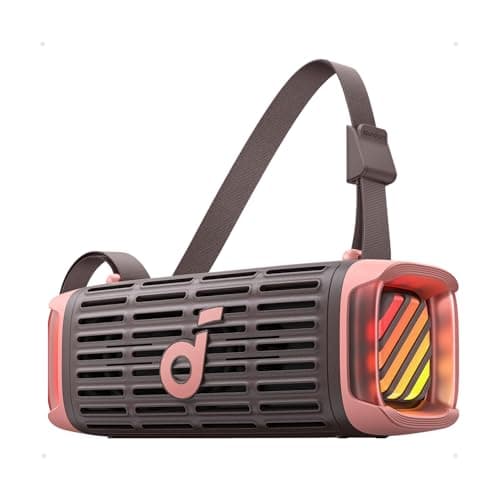
The Soundcore Boom 3i is a 50 W, 1.7 lb (780 g) outdoor speaker whose defining feature is not that it floats but how it floats: Soundcore weights it so it auto-corrects to upright, keeping the drivers facing out of the water instead of gurgling into it. It is IP68 — dust-tight and submersible — drop-tested from 3.28 ft (1 m), and lab-tested to 240 hours of salt spray under ASTM G85-equivalent conditions, which is the spec that matters if your water is the ocean. Soundcore quotes 16 hours of playtime, 96 dB of loudness and a 56 Hz low end with BassUp 2.0, over Bluetooth 5.3. The compromises are real: sixteen hours is short for an outdoor speaker, there is no charge-out for your phone, and Soundcore does not publish a battery capacity, a charge time or a driver complement.
This is the speaker that replaced the Soundcore Motion Boom in our registry when that model stopped being sold, and it is the site's standing answer for water that moves — kayaks, boats, riverbanks, the shoreline end of a beach day. It is worth being precise about why, because "waterproof" and "floats" are the two most casually used words in this category and neither of them means what buyers assume.
Every figure here is Soundcore's own published specification. Where Soundcore does not publish something — and there are several of those, listed plainly below — we say so rather than filling the gap. How we pick sets out the method.
What it does well
It floats the right way up, and that is a bigger deal than it sounds. A speaker that floats on its side or face-down has its drivers in or against the water, which does two things: it muffles everything above the bass, and it fills the grille cavity. Soundcore's Auto-Upright Floating weights the body so it auto-corrects to stay upright and keep sound facing forward. On a flat pool that is a nicety. In chop behind a boat, or in a river with a current, it is the difference between a speaker and a buoy. Waterproof speakers that float is where we rank that behavior across the category.
The salt rating is the specification almost nothing else at this price carries. Soundcore states the Boom 3i is engineered to withstand 240 hours of salt spray, lab-tested to ASTM G85-equivalent conditions, and describes that as five times the industry average. Salt is not water: it is a corrosive that attacks grilles, port covers, charging contacts and the metal inside a driver long after the speaker has dried. An IPX7 speaker that survives a lake can die slowly from a season of beach trips. If your use is coastal, this is the number to buy on — and the best waterproof speakers for the beach explains why sand is the other half of that problem.
IP68 plus a published drop rating is unusually complete sealing. The 8 means dust-tight — the top of the scale, not merely "well sealed" — and the 6 covers submersion under conditions the manufacturer specifies. Soundcore adds a 3.28 ft (1 m) drop test, which covers the realistic accident: off a gunwale, off a tailgate, off a dock. Most speakers publish one of those three figures. This one publishes all three. What IPX7 and IP67 actually mean is the primer on reading them properly.
It is water-bottle sized, which changes how it gets used. At 8.27 x 3.35 x 3.09 in and 780 g (27.5 oz) it clips to a pack rather than filling one, and the detachable strap means it hangs off a kayak grab line, a bike frame or a cooler handle. Compare that to the 11.6 lb of the Tribit StormBox Blast and you can see the trade immediately: the Blast is the speaker you drive to a location, the Boom 3i is the one you take with you once you are there.
Fifty watts with BassUp 2.0 is genuinely loud for the size. Soundcore quotes 96 dB of loudness and describes BassUp 2.0 as delivering deep 56 Hz bass. Fifty-six hertz from something this small is processing-assisted rather than cabinet-driven, and it is a real result — it is roughly where you stop noticing that the bottom octave is missing. Why cheap speakers sound cheap covers how that trick works and where it runs out.
The safety features are not marketing padding. Hold the BassUp button for five seconds and the speaker sounds a 96 dB emergency alarm that Soundcore says is clearly audible at up to 100 meters. There is also a Voice Amplifier that records a message and broadcasts it, and Buzz Clean, which uses the driver to shake water out of the grille — a practical answer to the muffled-after-swimming problem covered in why a speaker sounds muffled. On a kayak or a riverbank, a 96 dB alarm you can trigger without unlocking a phone is worth having.
The app does real work. EQ, BassUp 2.0, the lighting, the alarm, the voice amplifier and firmware updates all live in the Soundcore app, and TWS pairing splits a second unit into a stereo pair. That last point matters outdoors less than people expect — mono vs stereo explains why — but two of these at either end of a campsite is a reasonable use of the feature.
Where it cuts corners
Sixteen hours is short, and it is the main reason not to buy this speaker. An outdoor speaker's battery is its binding constraint, and sixteen quoted hours is well under the twenty-four this site treats as the norm — the Soundcore Boom 2 quotes 24, the JBL Charge 6 quotes 24 plus 4, the StormBox Blast was independently measured at 32.1. Quoted figures also assume moderate volume with the lights off, so a full day on the water with BassUp engaged will finish it. If you are out for a weekend without power, this is the wrong speaker. How long portable speakers last sets out what the quoted numbers actually describe.
It will not charge your phone. Soundcore lists charge-out as unsupported. Several speakers in this band double as a power bank, and on exactly the kind of trip this speaker is designed for — no socket, phone being used for navigation and photos — that omission is felt. If a power bank matters, the JBL Charge 6 is the obvious alternative and it is sealed to IP68 too.
Fifty watts in a cabinet this small is loud rather than deep. There is no physics shortcut: a body 3.35 in across cannot move the air a 11 cm woofer moves. What you get is midrange that cuts through moving water and wind, which is the right priority for the use case, and a low end that is present rather than physical. If what you actually want is bass you can feel, the best Bluetooth speakers for bass is the honest list and the answer there is a bigger box.
Soundcore does not publish the battery capacity, the charge time, the codecs, the driver complement or a frequency response. That is five specifications missing from the product page, and we are not going to invent them. The practical consequences: you cannot work out real runtime at a given volume, you cannot plan a charging stop, and you cannot tell whether the speaker supports anything beyond SBC and AAC. We have flagged the gap rather than papered over it, and how to choose a Bluetooth speaker explains why an unpublished spec is itself information.
There is no aux input listed. Soundcore publishes no 3.5 mm jack on this model, so treat it as Bluetooth-only. For a sealed IP68 body that is a defensible engineering decision — every port is a leak path — but it rules the speaker out for a projector, a turntable or a mixer. Speakers with an aux input covers what is left in that shrinking category.
The RGB light show is the fastest way to spend sixteen hours. It is the standard trade across this whole category and it bites harder here because the battery has less to give. The lights are controllable in the app; switching them off is free runtime. Speakers with lights is the category-wide version of this argument.
The Voice Amplifier is a recording feature, not a megaphone. Soundcore describes it as recording a voice message and broadcasting it. That is useful for a repeated call across a campsite; it is not live amplification, and it does not make this a speaker you can teach or coach through. If you need a voice to go through a speaker as you speak, you need a real microphone input — see speakers with a microphone input.
Soundcore sells a certified refurbished version at a significant discount, and that complicates the value case. It is worth knowing the option exists. It is also worth knowing that a refurbished sealed speaker has had its gasketing disturbed at least once, which is exactly the component the IP68 rating depends on. For a speaker bought specifically to go in water, we would pay the difference for new.
Specifications
| Specification | Figure |
|---|---|
| Rated output | 50 W with BassUp 2.0 |
| Quoted loudness | 96 dB |
| Quoted low-end reach | 56 Hz with BassUp 2.0 |
| Playtime | 16 hours |
| Battery capacity and charge time | Not published by Soundcore |
| Water and dust | IP68 — dust-tight and submersible; lab-tested to 240 hours of salt spray (ASTM G85-equivalent) |
| Drop rating | 3.28 ft (1 m) |
| Floating | Auto-Upright Floating — auto-corrects to keep the drivers facing out of the water |
| Bluetooth | 5.3, with TWS pairing for stereo across two units |
| Codecs | Not published by Soundcore |
| Drivers and frequency response | Not published by Soundcore |
| Charge out | Not supported |
| Wired audio input | None listed |
| Extra features | RGB light show, 96 dB emergency alarm audible to 100 m, Voice Amplifier, Buzz Clean |
| Dimensions | 8.27 x 3.35 x 3.09 in |
| Weight | 780 g (27.5 oz), about 1.7 lb |
| In the box | Speaker, detachable strap, USB-C cable |
How it compares
The Boom 3i itself, summarized
Soundcore Boom 3i
A floating outdoor speaker that rights itself in chop, built for the water and the dirt.
- What it does well
- Auto-upright floating that keeps the drivers out of the water, IP68 with a 1 m drop rating and 240 hours of lab salt spray behind it, 50 W and a quoted 96 dB from a 1.7 lb body, a detachable strap, a 96 dB emergency alarm audible to 100 m, Buzz Clean to shake water out of the grille, and a real app EQ.
- Where it cuts corners
- Sixteen hours of quoted battery, no charge-out, no aux input, no published battery capacity, charge time, codecs, drivers or frequency response, a light show that eats the runtime it can least afford, and a Voice Amplifier that records rather than amplifies live.
- Who it is for
- Kayaks, boats, rivers, shorelines and campsites — water that moves, and salt in particular.
- Battery: 16 hours
- Water rating: IP68 — submersible and dust-tight, lab-tested to 240 hours of salt spray, and it floats upright
- Output: 50 W with BassUp 2.0
- Weight: 1.7 lb (780 g)
#ad — we earn a commission on qualifying purchases. How this is funded · Price as of November 11, 2026
If you want the bass and can carry the size
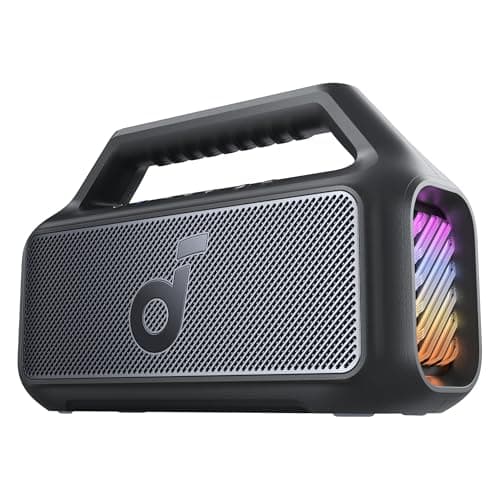
Soundcore Boom 2
The value answer to a party speaker: it floats, it is loud, and it lasts a day.
- What it does well
- A dedicated 50 W subwoofer plus two 15 W tweeters for up to 80 W peak, so the low end is hardware rather than processing, a quoted 24 hours instead of 16, a carry strap, and it floats. Same brand and same app, markedly more speaker.
- Where it cuts corners
- IPX7 rather than IP68, so no dust rating and no salt-spray claim — it is a lake and pool speaker, not a coastal one. It is bulky enough to live in the car, the 24 hours assumes BassUp and the lights are off, and there is no aux input.
- Who it is for
- Pools, lakes and backyards where output matters more than clipping it to a pack.
- Battery: Up to 24 hours at 50% volume with BassUp and lights off
- Water rating: IPX7 — submersible to 1 m for 30 minutes, and it floats
- Output: Up to 80 W peak output (a 50 W subwoofer plus two 15 W tweeters)
#ad — we earn a commission on qualifying purchases. How this is funded · Price as of November 11, 2026
If it is going to get dropped, not soaked
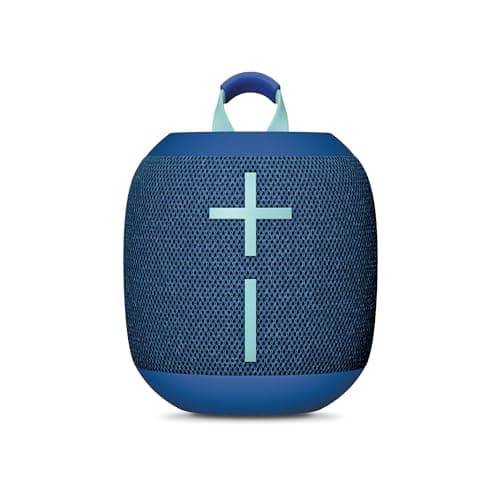
UE Wonderboom 4
The one to buy if the speaker is going anywhere near water.
- What it does well
- Rated for 5 ft drops onto concrete, sealed to IP67 against dust as well as water, and it floats. The 360-degree output means it does not matter which way it is facing, which is genuinely useful on a boat where nothing stays where you put it.
- Where it cuts corners
- Fourteen hours is shorter still, there is no aux input, no stereo imaging, no salt-spray claim and no published output figure. Ultimate Ears charges close to JBL money for it.
- Who it is for
- Rough handling first, water second — and anyone who has already killed one speaker.
- Battery: 14 hours
- Water rating: IP67 — submersible to 1 m for 30 minutes, dustproof, and it floats
- Weight: 14.81 oz (420 g)
#ad — we earn a commission on qualifying purchases. How this is funded · Price as of November 11, 2026
If you need the power bank
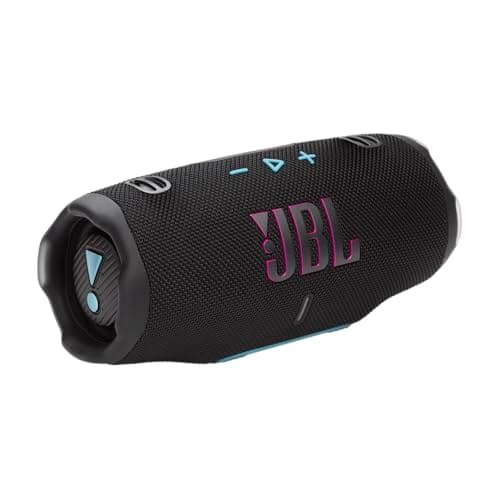
JBL Charge 6
The battery-life benchmark, with a power bank built into the back.
- What it does well
- IP68 like the Boom 3i, but with 24 hours plus 4 in Playtime Boost, USB-C lossless audio, Auracast and a USB output that will charge a phone — the feature the Boom 3i specifically does not have. The build is a step up and so is the resale value.
- Where it cuts corners
- It costs a good deal more, it does not float and JBL makes no salt-spray claim, so it is a worse choice for a kayak or a shoreline. No aux input here either, and the battery is not replaceable.
- Who it is for
- Longer days away from a socket where the phone needs charging as much as the music needs playing.
- Battery: 24 hours, or up to 28 hours with Playtime Boost enabled
- Water rating: IP68 — submersible to 1.5 m for 30 minutes, dustproof
#ad — we earn a commission on qualifying purchases. How this is funded · Price as of November 11, 2026
Who should skip it
- Anyone out for a full day or a weekend without power. Sixteen hours is the hard limit. The best speakers for camping ranks on runtime.
- Anyone who needs the speaker to charge a phone. Charge-out is not supported. The JBL Charge 6 is the straightforward swap.
- Anyone who wants bass they can feel. Fifty watts in a 3.35 in body is loud, not deep. The best Bluetooth speakers for bass is the honest list.
- Anyone with a wire. No aux input is listed. Speakers with an aux input covers the alternatives.
- Anyone filling a backyard. This is a personal and small-group speaker. The best outdoor party speakers is the right page.
If the water is the whole point, the best waterproof speakers for a kayak or boat is the roundup this speaker leads and the best for the pool is where the floating behavior gets compared properly. If you are weighing it against the rest of Soundcore's range, the Soundcore brand page lays out which model covers which job, and Soundcore vs JBL is the cross-brand version of the same question.
Frequently asked questions
Does the Soundcore Boom 3i really float upright?
How long does the Soundcore Boom 3i battery last?
Is the Soundcore Boom 3i good for saltwater?
Can the Soundcore Boom 3i charge my phone?
Does the Soundcore Boom 3i have an aux input?
How loud is the Soundcore Boom 3i?
What is the Boom 3i's emergency alarm?
Is the Boom 3i the same as the Soundcore Motion Boom?
Update log
- First publication. Specifications taken from Soundcore's own Boom 3i product page, including the 240-hour salt-spray figure and the five specifications Soundcore does not publish, which are named here rather than estimated.
Sources
Every specification quoted above comes from the manufacturer or retailer listing below. We publish no measurements of our own — see how we pick.
- Soundcore — Boom 3i product page (manufacturer specifications)
- Soundcore — Boom 2 product page (manufacturer specifications)
- JBL — Charge 6 product page (manufacturer specifications)
- Ultimate Ears — Wonderboom 4 product page (manufacturer specifications)
- IEC 60529 — the international standard behind IP ratings
- Battery University — how lithium-ion batteries age (BU-808)
Read next
Waterproof
The best Bluetooth speakers for kayaking and boating in 2026
Floating picks with real tether points — for water where a drop means the speaker is gone.
Waterproof
The best Bluetooth speakers for the pool in 2026
Speakers that float as well as survive — plus why an IPX7 rating on its own is not enough here.
Waterproof
The best Bluetooth speakers for the beach in 2026
Dust-sealed picks for sand and salt — and the one digit in the rating that decides this category.
Outdoor & Party
The best Bluetooth speakers for camping in 2026
Campsite picks chosen for battery and packability rather than volume — the opposite of a party speaker.
Brands & Alternatives
Soundcore: the most speaker per dollar, with one caveat
Anker's value range assessed — which models earn the hype and the spec claim to discount.
Reviews
Party-class bass hardware for the money — and the battery claim that needs translating.
Outdoor & Party
The best Bluetooth speaker for fitness classes
Why a class is a voice problem before it is a volume problem, and the five speakers that get an instructor through a day.