Reviews
JBL Xtreme 5 review
The newest Xtreme is the toughest and the deepest-reaching one JBL has made. It is also the heaviest thing on this site, and it costs more than most people should spend on a speaker.
By Ryder M.Published
 Field-tested picks · 2026
How we are funded: Thump & Tote earns a commission when you buy through our Amazon links, at no extra cost to you. It never changes which speaker we put first — see how we pick and our affiliate disclosure.
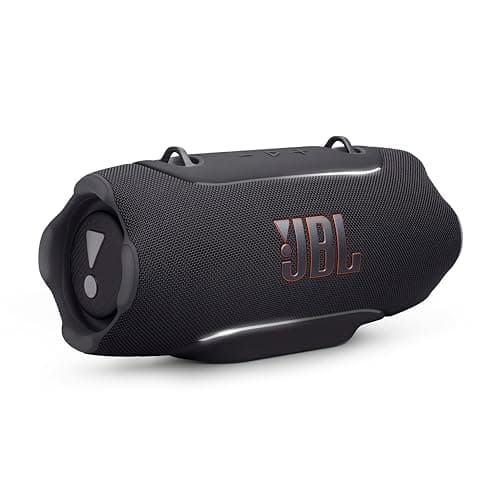
The JBL Xtreme 5 is a 6.38 lb (2.9 kg) portable built around one 98 x 145 mm woofer and two 20 mm tweeters, which is a different architecture from the Xtreme 4's pair of 70 mm woofers. JBL publishes a rated output of 90 W RMS for the woofer plus 2 x 20 W RMS for the tweeters on AC power, dropping to 60 W plus 2 x 15 W on battery — so the headline 130 W figure is the plugged-in number, and the speaker you carry to a park is a 90 W speaker. Frequency response is 40 Hz to 20 kHz, playtime is up to 24 hours plus 4 more with Playtime Boost, and the 68 Wh battery takes 3.5 hours to fill. It is IP68 and JBL additionally calls it drop-proof. There is no aux input, no power adapter in the box, and it lists several times above the band this site thinks most people should shop in.
This site is written for the buyer who wants most of the result for a fraction of the money, which makes a flagship-priced speaker an awkward subject. We cover it for two reasons. First, the Xtreme line is the speaker people upgrade to when a Flip or a Charge runs out of bass outdoors, so the question "is the new one worth it" gets asked constantly. Second — and this is the more useful half — a new generation shipping is the single most reliable way the outgoing one gets cheap. Understanding what changed is how you work out whether the discount on last year's model is a bargain or a trap.
Everything in the table at the bottom is JBL's own published figure. Nothing on this page is measured by us; where an independent measurement exists we attribute it. How we pick sets out the method.
What changed from the Xtreme 4
The driver layout is the real news and almost nobody leads with it. The Xtreme 4 used two 70 mm woofers; the Xtreme 5 uses one woofer measuring 98 x 145 mm. That is a single cone with far more surface area than either of the old pair, and surface area is what moves air at low frequencies. The published floor drops from 44 Hz to 40 Hz as a result. Four hertz sounds like nothing written down; at the bottom of the audible range it is most of the difference between hearing a kick drum and feeling one.
The trade is stereo separation. Two woofers sat at opposite ends of the Xtreme 4's cabinet; one woofer sits in the middle of the Xtreme 5's. SoundGuys, who measured the speaker, note that the compact enclosure limits left-to-right separation — and with a single bass driver there is physically less to separate. If you want to understand why that matters less outdoors than it sounds, mono vs stereo is the page.
The other changes are smaller and go in both directions. Sealing improves from IP67 to IP68 and JBL adds a drop rating, without publishing a drop height. Bluetooth moves from 5.3 to 6.0, bringing LC3 alongside SBC and AAC. Rated AC output rises from 100 W to 130 W. Against that: Playtime Boost drops from six bonus hours to four, and the speaker puts on over a pound and a half — 2.1 kg became 2.9 kg. The full column-by-column version is on JBL Xtreme 5 vs Xtreme 4.
What it does well
Forty hertz from a battery speaker is a genuinely low floor. Only the Soundcore Boom 2 Plus matches it among the speakers we cover, and it does so with a 2 x 30 W pair rather than a single 90 W driver. Outdoors — where there are no walls to reinforce the low end for free — the bottom octave is the first thing a small speaker loses, and it is the reason people outgrow a Flip. The Xtreme 5 is the JBL that stops that happening. Why cheap speakers sound cheap explains the physics of what you are paying for here.
AI Sound Boost is a real feature, not a sticker. JBL's processing watches the driver and pushes it closer to its mechanical limit without letting it distort, which is why reviewers describe the Xtreme 5 as staying clean at volumes where it should be breaking up. This is the same trick that makes modern small speakers sound bigger than their size, applied to a cabinet that was already large. It is also why the wattage figures tell you so little — see how many watts is loud.
The battery beats its own spec. SoundGuys measured 30 hours and 6 minutes at a steady 80 dB with the ambient lighting switched on, against JBL's quoted 24 plus 4. That is unusual: manufacturer battery figures are normally optimistic. A 68 Wh cell is a large battery by portable-speaker standards and this one is being driven sensibly. How long portable speakers last covers why quoted and real figures diverge.
IP68 plus a drop rating is the toughest specification on this site. IP68 means dust-tight and sealed against continuous immersion, a step beyond the IP67 the Xtreme 4 carried. The drop claim has no published height behind it, so treat it as a construction statement rather than a number — but a speaker JBL is willing to call drop-proof is a speaker built differently from one it is not. What IPX7 and IP67 actually mean is the primer.
The strap has floating hooks. A small thing that changes how the speaker gets used: the shoulder strap clips on and off without threading, so it goes on a cooler handle or over a shoulder in a second. On a 6.38 lb speaker, the carry system is not a detail.
Lossless USB-C audio, a powerbank and Auracast. USB-C carries audio in as well as power out at up to 11 V / 2 A, so a laptop gets a wired digital path and a phone gets a charge. Auracast links it to JBL's current range — Auracast vs PartyBoost explains why that matters if you already own a JBL. SoundGuys also report a 7-band custom EQ in the app, which is more control than most premium speakers give you.
Where it cuts corners
6.38 lb is the heaviest speaker on this site, and the Xtreme 4 was already heavy. Nearly three kilograms is a speaker you deliver to a location, not one you carry around at it. It will not go in a suitcase without consequences and it is a poor traveling companion — the best speakers for travel ranks on exactly the axis this one loses. For reference, you could carry the JBL Charge 6 and the Flip 7 together and still be lighter.
There is no power adapter in the box. JBL's own documentation puts an asterisk on the 10-minute quick charge: it needs a PD adapter, which is not included. A speaker at this price arriving without the charger required to use its headline charging feature is worth saying plainly. Any 20 V / 3 A USB-C PD brick will do it, and you will probably have one — but it is a cost JBL has moved onto you.
Playtime Boost went backwards. The Xtreme 4 offered 24 hours plus 6; the Xtreme 5 offers 24 plus 4. Two fewer bonus hours is not a disaster and it is the first time this line has gone the wrong way on a headline number. If you were expecting every figure to improve generation over generation, it did not.
Still no aux input. Four generations in, there is no 3.5 mm jack, so a turntable, a TV or a mixer rules this speaker out entirely. If a wire is part of your setup, speakers with an aux input is the list to read instead — and note that the far cheaper JBL PartyBox Encore Essential 2 does have one.
The ambient lighting is the fastest way to spend the battery. JBL's own playtime note says the figure varies with ambient light themes, and SoundGuys flag lighting alongside volume and bass-heavy material as the things that drain it. The lights are genuinely nice. They are also optional, and switching them off is free runtime. Speakers with lights is the honest version of this argument across the category.
Playtime Boost and firmware updates need the app. Two of the things you paid for are gated behind installing JBL Portable and keeping an account. That is the industry norm now and it is still a dependency on a speaker that should outlive several phones.
The price is the real objection. This is several times the ceiling of the $50-to-$100 band where this site argues most people's requirements actually live, and SoundGuys' own conclusion is that the Xtreme 4 will be the better value once discounts land. That is our view too. Is JBL worth it works through the brand premium properly, and the best for the money is where we would send most people first.
One independent score worth knowing about. SoundGuys' MDAQS rating — a predicted-preference model rather than a listening opinion — came out at 2.7 overall, with timbre at 3.1, distortion at 2.7 and immersiveness at 1.7. That immersiveness figure is the single-woofer trade-off showing up in a measurement. It is not a verdict on whether you will enjoy the speaker; it is a reminder that a big mono cabinet does scale, not imaging.
Specifications
| Specification | Figure |
|---|---|
| Transducers | 1 x 98 x 145 mm woofer, 2 x 20 mm tweeters |
| Rated output power | 1 x 90 W RMS woofer + 2 x 20 W RMS tweeter (AC); 1 x 60 W + 2 x 15 W (battery) |
| Frequency response | 40 Hz to 20,000 Hz |
| Signal-to-noise ratio | Greater than 80 dB |
| Battery | Li-ion 68 Wh (7.2 V / 9444 mAh) |
| Charge time | 3.5 hours at 20 V / 3 A; 10 minutes gives about 2 hours |
| Playtime | Up to 24 hours, plus 4 with Playtime Boost |
| Measured playtime (SoundGuys) | 30 hours 6 minutes at 80 dB with lighting on |
| Bluetooth | 6.0 — A2DP 1.4, AVRCP 1.6; SBC, AAC and LC3 |
| Water and dust | IP68 — dust-tight, sealed against continuous immersion; JBL also rates it drop-proof |
| Dimensions | 346 x 165 x 155 mm (13.6 x 6.5 x 6.1 in) |
| Weight | 2.9 kg (6.38 lb) |
| Ports | USB-C in and out; charge out at 5 V/3 A, 9 V/2 A, 11 V/2 A |
| Wired audio input | None — no 3.5 mm aux |
| Maximum operating temperature | 40 C (104 F) |
| In the box | Speaker, quick-start guide, warranty card, shoulder strap. No power adapter |
Alternatives worth knowing about
The Xtreme 5 itself, summarized
JBL Xtreme 5
One big woofer instead of two small ones, IP68 and a drop rating — the most rugged Xtreme, and the heaviest.
- What it does well
- A single 98 x 145 mm woofer reaching a published 40 Hz, AI Sound Boost that holds the low end together near the top of the range, IP68 plus a drop claim, Bluetooth 6.0 with LC3 and Auracast, lossless USB-C audio, a powerbank, a quick-release strap with floating hooks, and a measured 30 hours of real runtime.
- Where it cuts corners
- 6.38 lb, no power adapter in the box, Playtime Boost down from six bonus hours to four, no aux input of any kind, lighting that eats the battery, app-gated features, weaker stereo separation than the two-woofer Xtreme 4, and a price several times this site's value band.
- Who it is for
- Open ground with a crowd on it, where bass has nothing to reflect off and the speaker gets set down rather than carried.
- Battery: Up to 24 hours, plus 4 more with Playtime Boost; 10 minutes of charging gives about 2 hours
- Water rating: IP68 — dust-tight and sealed against continuous immersion. JBL also calls it drop-proof, without publishing a drop height
- Output: One 98 x 145 mm woofer and two 20 mm tweeters; 1 x 90 W RMS plus 2 x 20 W RMS on AC power, 1 x 60 W RMS plus 2 x 15 W RMS on battery
- Weight: 6.38 lb (2.9 kg)
#ad — we earn a commission on qualifying purchases. How this is funded · Price as of November 11, 2026
The value play: last year's model
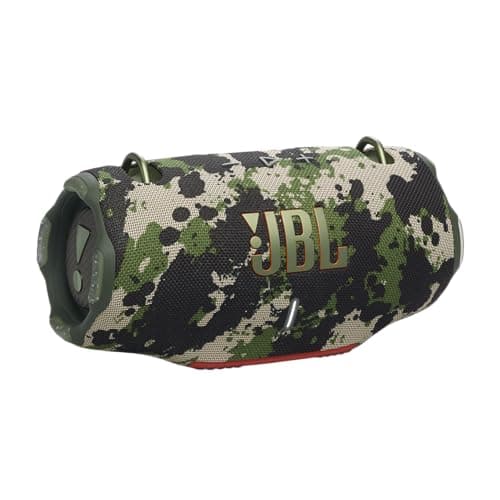
JBL Xtreme 4
Two woofers and two bass radiators — the most convincing low end JBL puts in a carryable box.
- What it does well
- Two 70 mm woofers at opposite ends of the cabinet give it better left-to-right separation than the single-woofer 5, the battery is user-replaceable so you can carry a spare, Playtime Boost adds six hours rather than four, and it weighs a pound and three-quarters less. Same 68 Wh cell, same 3.5-hour charge, same powerbank, same Auracast.
- Where it cuts corners
- A 44 Hz floor rather than 40 Hz, IP67 rather than IP68 with no drop claim, Bluetooth 5.3 without LC3, and 100 W on AC against 130 W. It is also the outgoing generation, so stock will thin out and colorways will disappear.
- Who it is for
- Almost everyone choosing between the two — as soon as the discount on the outgoing model opens up.
- Battery: Up to 24 hours, plus 6 more with Playtime Boost
- Water rating: IP67 — submersible to 1 m for 30 minutes, dustproof
- Output: Two 70 mm woofers and two 20 mm tweeters with dual bass radiators
- Weight: 4.63 lb (2.1 kg)
#ad — we earn a commission on qualifying purchases. How this is funded · Price as of November 11, 2026
The same bass floor for much less
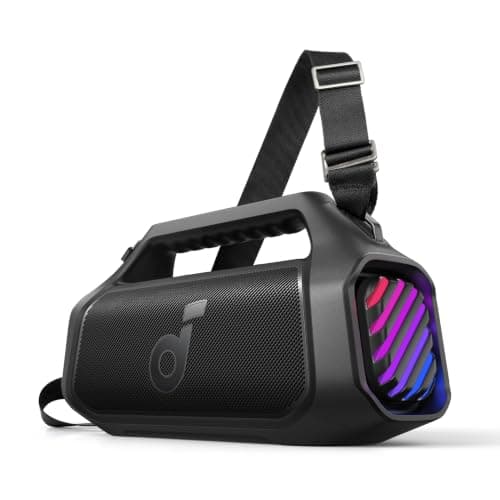
Soundcore Boom 2 Plus
Two woofers, two tweeters and an aux jack — the most bass hardware per dollar in a carryable box.
- What it does well
- Matches the Xtreme 5's published 40 Hz floor, floats, and carries a BassUp engine plus a real app EQ for a fraction of the money. On paper it is the cheapest route to the bottom octave in this category.
- Where it cuts corners
- The build is not in JBL's class and neither is the resale value; its IP rating does not include a drop claim; and Soundcore's app is where a lot of its sound quality lives, so you are committing to the ecosystem.
- Who it is for
- Anyone who wants the deep end without the JBL premium and will forgive a less rugged shell.
- Battery: Up to 20 hours at 50% volume with BassUp and the light effects switched off
- Water rating: IPX7 — submersible to 1 m for 30 minutes, and it floats
- Output: 100 W as standard, up to 140 W in BassUp 2.0 mode, from two 50 W woofers and two 20 W tweeters
- Weight: 8.4 lb
#ad — we earn a commission on qualifying purchases. How this is funded · Price as of November 11, 2026
If you are carrying it, not delivering it
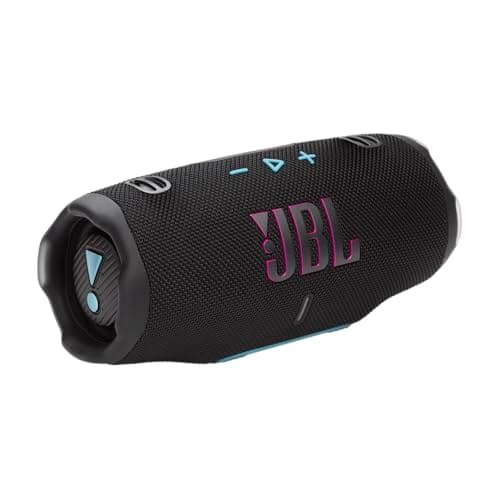
JBL Charge 6
The battery-life benchmark, with a power bank built into the back.
- What it does well
- IP68, 24 hours, USB-C lossless audio, a powerbank and Auracast in something you can hold in one hand. For most people most of the time this is the JBL to buy, and it costs well under half what the Xtreme 5 does.
- Where it cuts corners
- Nowhere near the Xtreme 5's low-frequency reach or output, no replaceable battery, and no aux input here either. Outdoors with a crowd it will be working hard where the Xtreme is coasting.
- Who it is for
- The large majority of buyers, who want one speaker that travels as well as it entertains.
- Battery: 24 hours, or up to 28 hours with Playtime Boost enabled
- Water rating: IP68 — submersible to 1.5 m for 30 minutes, dustproof
#ad — we earn a commission on qualifying purchases. How this is funded · Price as of November 11, 2026
Who should skip it
- Anyone who has to carry it far. 6.38 lb is a commitment. The best speakers for travel is the honest alternative list.
- Anyone with a wire. No aux, four generations running. Speakers with an aux input covers what is left.
- Anyone who wants a microphone in it. The Xtreme line has never taken one. Speakers with a microphone input is the narrow category that does.
- Anyone shopping on value. Best under $100 and best for the money are where this site actually points people.
- Anyone buying for a pool. IP68 survives immersion; JBL does not claim it floats. Waterproof speakers that float covers the ones that do.
If you have already decided on an Xtreme and only need to know which one, go to Xtreme 5 vs Xtreme 4. If you are not sure the Xtreme class is the right size at all, what size speaker do I need is the page that settles it, and the loudest for the money is where the output question gets answered without the brand premium.
Frequently asked questions
Is the JBL Xtreme 5 worth upgrading from the Xtreme 4?
How long does the JBL Xtreme 5 battery last?
Is the JBL Xtreme 5 really 130 watts?
Is the JBL Xtreme 5 waterproof?
Does the JBL Xtreme 5 have an aux input?
Does the JBL Xtreme 5 come with a charger?
Can you replace the JBL Xtreme 5 battery?
How much does the JBL Xtreme 5 weigh?
Update log
- First publication. Specifications taken from JBL's own Xtreme 5 specification sheet, including the AC-versus-battery output split and the absence of a power adapter in the box, both of which most coverage of this speaker omits.
Sources
Every specification quoted above comes from the manufacturer or retailer listing below. We publish no measurements of our own — see how we pick.
- JBL — Xtreme 5 specification sheet (PDF, manufacturer specifications)
- JBL — Xtreme 5 product page
- SoundGuys — JBL Xtreme 5 review (independent battery test and MDAQS scoring)
- Tom's Guide — JBL Xtreme 5 review
- JBL — Xtreme 4 specification sheet (PDF)
- IEC 60529 — the international standard behind IP ratings
- Battery University — how lithium-ion batteries age (BU-808)
Read next
Head-to-Head
JBL Xtreme 5 vs Xtreme 4: which should you buy?
What a generation actually bought you: 4 Hz, one IP digit, and 0.8 kg of extra weight.
Reviews
The one JBL portable whose battery you can change — and the three things reviewers agree it gets wrong.
Head-to-Head
JBL Xtreme 4 vs Charge 6: which should you buy?
The honest split: about 10 Hz more bass and a swappable battery, against half the weight and a better rating.
Reviews
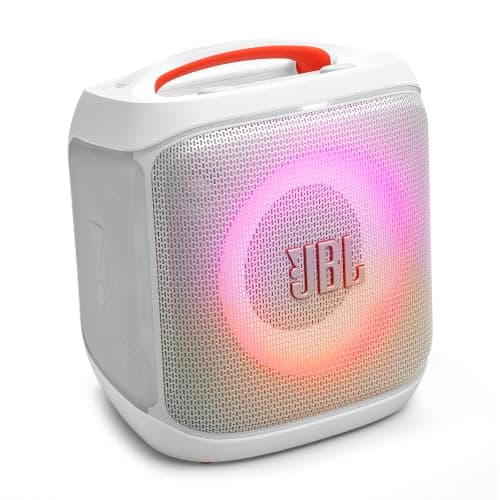
JBL PartyBox Encore Essential 2 review
Mic in, guitar in, aux in and 15 hours off the battery — against IPX4 and 13.67 lb.
Outdoor & Party
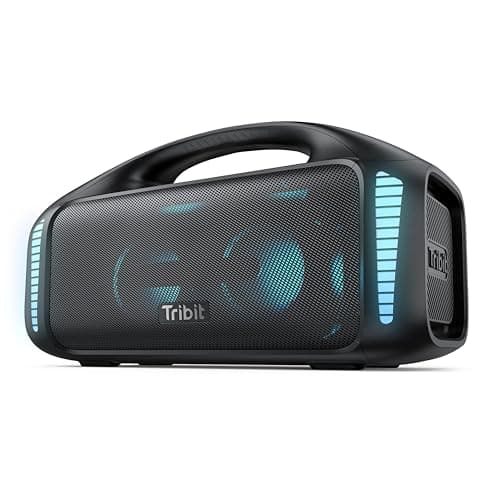
The loudest Bluetooth speakers for the money in 2026
Genuinely loud speakers ranked on output per dollar — and why wattage figures cannot be compared.
By Price
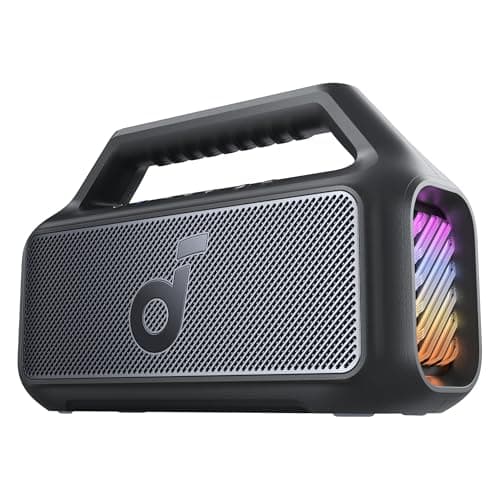
The best Bluetooth speakers for bass in 2026
Speakers with real low-end hardware, ranked by what they move rather than what the EQ claims.
Brands & Alternatives
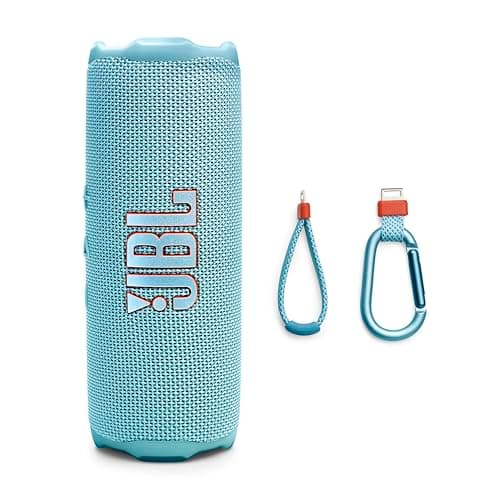
Is JBL worth it? A direct answer
The brand-premium question answered directly, with the one variable that decides it.